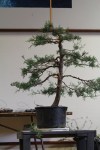
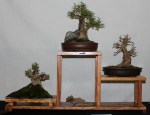
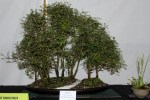
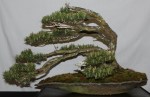
Boon Manaktivipart visits New Zealand

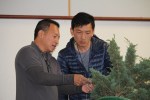
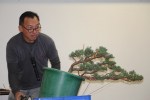
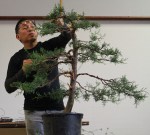
The guest artist at the recently held New Zealand National Bonsai Convention in Christchurch was Boon Manaktivipart. Boon is one of those professionals who shares his very wide and in-depth knowledge freely. Some of the seasoned veterans of Bonsai in New Zealand were glued to his words over the just more than two days in Christchurch.

New Zealand National Bonsai Convention and Show (1)

The New Zealand National Convention and National Show recently took place in Christchurch, the city which was badly shaken by large earthquakes a few years ago. It was wonderful to see the convention hosted there and to me personally, a great occasion, as it was the first time I have been there after the earthquakes. The rebuild is in full swing, but the devastation is still clearly visible.

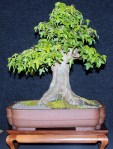
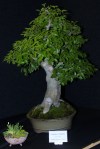
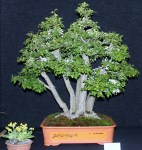
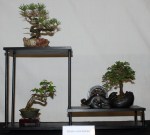
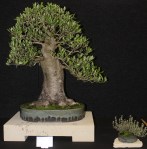
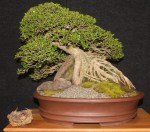
The Friday saw the New Talent competition with five competitors and later that night a wonderful performance by Chinese performers preceded the official opening. Boon Manakitivipart was also introduced to the crowd. The following two days were filled with demonstrations by Boon and other local artists with the prizegiving ceremony and dinner on the Saturday night. Below are a few of the trees on display at the convention. New Zealand trees have come a long way and is progressing rapidly. For a very young Bonsai country and no real Bonsai market to speak of, we can be proud of what was on display here and especially the great organisation behind this convention. Next year we will meet in Auckland with Peter Warren our headliner.

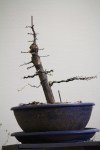
Another blog post will have more photos and also the demonstration trees that Boon worked on.

Fibonacci and Bonsai

golden1In my previous blog, which focused on the seven Da Vinci principles, I started to think a bit more about Da Vinci’s use of mathematical proportions in Art and especially Bonsai.

Leonardo Da Vinci has long been associated with the goldleonardo_fibonaccien
ratio. Da Vinci created the illustrations for the book, The Divine Proportion, by Luca Pacioli. It was written in about 1497 and first published in 1509. Pacioli was a contemporary of Da Vinci’s. In the book, Pacioli writes of mathematical and artistic proportion, especially the mathematics of the golden ratio and its application in art and architecture. The golden ratio and the Fibonacci numbers or series, comes from the work of Leonardo Bonacci, also known as Fibonacci, an Italian mathematician. Many writings exist about Fibonacci, Da Vinci and the applications of the mathematical ratios and numbers in art, nature and a few other areas as well. I will focus a bit more on Bonsai design and am hoping to bring some of this “divine proportions” to Bonsai design. First a bit more about the Mathematics involved.

As said, much has been written about the Fibonacci numbers and its appearance in various patterns of spirals in especially leaves and seeds. The Fibonacci series is a series of numbers formed by adding the previous two numbers together to get the next number.

0, 1, 1, 2, 3, 5, 8, 13, 21, 34, 55, 89, 144, 233, etc.

In Bonsai, the theory is that when you cut a stem, tfib01he stem puts
out two growing shoots during one growth period. This could be more (pines or where whorls are formed), but the theory is that we keep two stems. If you keep on cutting these shoots as per the illustration, you will increase the number of smaller shoots over time. This is called increasing the ramification of your Bonsai tree. The theory is that if it is done according to the numbers as found in the Fibonacci series, that you will have a visually more pleasing appearance.

Further to this, the ratio of two successive numbers in the Fibonacci series can be calculated by dividing each number by the number before it. The ratio seems to be settling down to a particular value, which is called the golden ratio or the golden number. The value of this ratio is approximately 1.618034. This is often represented by the Greek letter Phi.

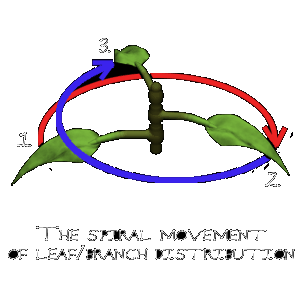
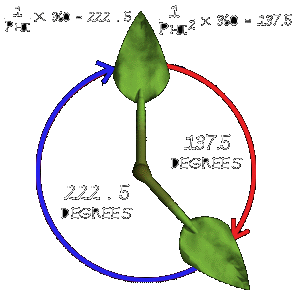
The arrangement of stems around the trunk could also be of interest here. When the golden ratio is used in a mathematical equation in relation to circles, it is found that stems / branches could be in a visually ideal position if they are 137.5 degrees or 222.5 degrees (make up 360 degrees in a circle) apart from each other.

phiplnt1phiplnt2

For completeness sake, I will also try to explain the Fibonacci rectangles and spirals here. If we start with two small squares of size 1 next to each other and we then place on top of these two squares a square of size 2 (1 + 1) and then carry on like that as illustrated in the diagram, rectangles of various sizes can be drawn. These are the Fibonacci rectangles.

golden-rectangle

A spiral can also be drawn in the squares, a quarter of a circle in each square. These spirals are seen in the shape of shells and also in the arrangement of seeds in flowering plants. The spiral in the squares makes a line from the centre of the spiral increase by a factor of the golden number in each square. Points in the spiral are 1.618 times as far from the centre after a quarter turn. In a whole turn the points on a radius out from the centre are 1.6184 (6.854) times further out than when the curve last crossed the same radial line.

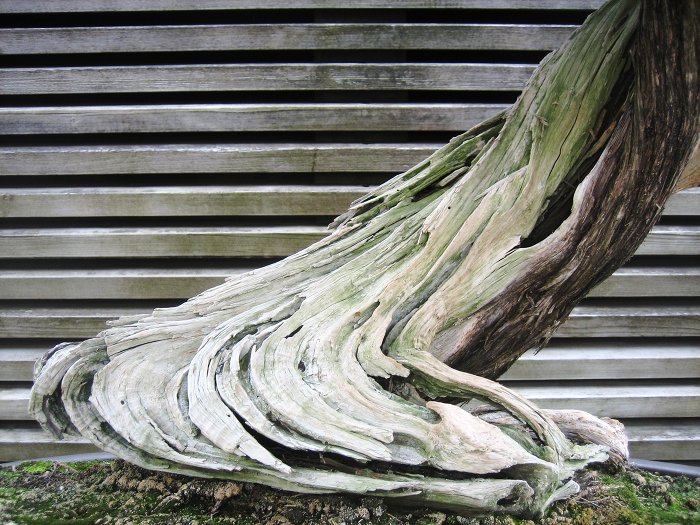
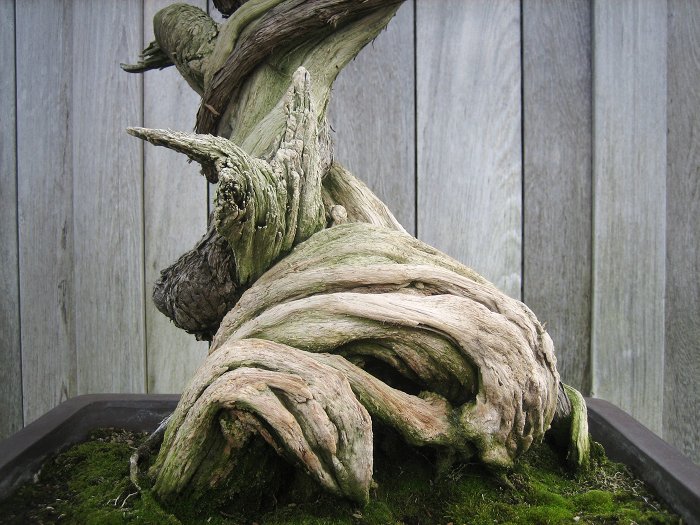
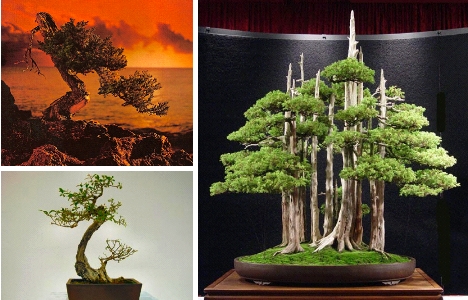
Am I the only one seeing spirals in these examples of deadwood?

bonsai_huntington_library_2bonsai_huntington_library_1

Where does this all fit in? That depends on you and how far you want to take this. For me it is just interesting and something that can be kept in the back of the mind while styling Bonsai trees. I will be looking a bit closer at the shape of curves / spirals in future and I will also be looking at where I place especially the first two branches. Maybe that 137.5 degrees angle is not so silly after all?


Leonardo Da Vinci and Bonsai

Yesda-vinci-profile, you are correct. Da Vinci never designed Bonsai, as a
matter of fact, there is no evidence to indicate that he even saw a Bonsai. What is this article about then, you may ask. In my quest to understand more about the creative process and trying to better myself as a creative person, I explore a lot of different theories and principles and try to open my mind to as many influences as possible to find my own rightful place within the creative space. My chosen field is that of Bonsai creation. We all know that the roots of Bonsai are firmly established in Chinese and Japanese culture. We also know that Bonsai as a creative activity has now spread to all corners of the world and it is clear that other influences are being incorporated into the creative concepts serving as foundations for Bonsai. The recent Artisans Cup in the USA is an example of this, but there are many others spread throughout Europe. A very distinctive style is emerging out of Africa as well. Why not look at the seven Da Vincian principles as a source of inspiration or direction in relation to Bonsai design?

IMG_3129

There are seven Da Vincian principles that can be used to give direction to a person’s life in exploring creativity. These are:

  • Curiosity – An insatiably curious approach to life and an unrelenting quest for continuous learning.
    • This principle can directly be implemented in the life of any Bonsai artist. Being curious about life in general and then also the creative process surrounding Bonsai cultivation, is very important in establishing the next steps for growth. Asking questions, exploring concepts, trying new designs on the creative side, but also being curious about the horticultural process underlying Bonsai are all part and parcel of the Bonsai artist’s grounding. I encourage artists to make notes, read often, watch videos, talk to other Bonsai artists, attend conferences and to never stop asking questions. Leonardo da Vinci’s notebooks amount to over 7000 pages.
  • Demonstration / Independent Thinking – A commitment to test knowledge through experience, persistence and willingness to learn from mistakes.
    • As Bonsai artists we are involved in a practical application of centuries of knowledge and techniques. The last few decades saw an explosion of information and it is our job as artists to make sense of all of this and to apply what suits your own philosophy and style to your own designs. Yes, you can copy other people, but I am convinced that real satisfaction and personal growth comes when you use all of your knowledge and skill and create something new. This can be applied in a very practical way in Bonsai as each plant is unique.
  • Sensation – The continual refinement of the senses, especially sight, as the means to enhance experience.
    • According to Da Vinci, experience is delivered through the senses: sight, sound, touch, taste and smell. Bonsai creation is all about using your senses, especially sight, touch and smell. The more sense you can incorporate into your interaction with your trees, the more fulfilling the experience. You learn and experience through your senses. One of the problems that I experience is that modern day living is too noisy and very visual. So much so that it leads to sensory overload. Something that I need to work on more is to refine my sensory experiences by deliberately focussing on those sensory stimuli that matters during the creative process and to block or filter the “noise” out.
  • Smoke (Sfumato) / Embrace uncertainty – Becoming open to the unknown. A willingness to embrace ambiguity, paradox and uncertainty.
    • In her blog, Andrea Balt mentions that we cannot “make use of our full creative potential without the ability to embrace uncertainty. An open, always questioning mind is our creativity’s best ally.” In Bonsai there are many uncertainties, especially when it comes to severe styling processes. Will a tree flourish after severe root pruning, how will it react to wiring, did I cut too much, etc.? There are many different thoughts and ideas around when things should and should not be done when it comes to repotting, lifting yamadori, using chemicals, etc. Embrace the unknown.
  • Art and Science – Whole-brain thinking. The development of the balance between science and art, logic and imagination.
    • Your brain operates as a whole organ. Society has been telling us for a long time that one half is more dominant than the other. As an artist you are using both halves. You are programmed to be creative, it is just a case of exploring and finding your creative roots. The capacity is already there. This principle can also relate to the two parts of Bonsai creation. There is the creative / art side and then there is the science / horticulture side. Both are equally important. Embrace both. It could be that one of these attracted you more to Bonsai than the other. It is your task as a creative Bonsai artist to get yourself up to speed with both aspects. A beautifully created dead Bonsai is as unappealing as an ugly, living Bonsai. Study the art of science and study the science of art. Da Vinci was ambidextrous, something you can try to help with the development of the motor functions of both halves of your brain.
  • The body (mind-body care) – The cultivation of grace, ambidexterity, fitness and poise. Balancing the body and mind.
    • This one is self-explanatory. A healthy body is needed to dig trees, cultivate the trees, carry them around, etc. There is more to it than just being fit enough to do what you have to do around your trees. There is also the healthy body – healthy mind concept that is so important in the creative process. This principle was taken very seriously by Da Vinci in his day-t-day life. Mild exercise and good nutrition with ample rest serve as foundations for what is needed.
  • Connection – A recognition of and appreciation for the interconnectedness of all things and phenomena. Systems thinking.
    • Da Vinci said: “Learn how to see. Realize that everything connects to everything else.” The growing medium that you plant your Bonsai in, the aesthetic effect of pot and tree, the light that all leaves get, the link between water and nutrition, your interaction with the tree, everything is connected. You are connected to the tree and everything the tree is connected to.

For you to be a better Bonsai artist and based on the Da Vinci principles, in summary: Be curious and never stop learning. Test yourself and be independent in a practical way. Use all of your senses when interaction with your creativity. Embrace the unknown and explore. Use your logical and creative powers. Look after yourself and realise that everything in life is connected.

References

Gelb, Michael. J. 2014. Creativity on Demand. How to ignite and sustain the fire of genius. Colorado: Sounds True

www.davinci.ac.za/

www.andreabalt.com/7-ways-to-think-like-leonardo-da-vinci/

Sphagnum Moss and Bonsai

Sphagnum moss is used in a variety of ways in conjunction with growing Bonsai. The main characteristic of Sphagnum that makes it useful to Bonsai growing is its ability to hold a lot of water. Sphagnum moss plants can hold 16–26 times as much water as their dry weight.sphagnum

Sphagnum also does not decay easily as it contains phenolic compounds in its cell walls. It therefore can be used in applications that can take a long time to complete. It does not break down as easily as other growing mediums. Sphagnum originating from peat bogs is known to aid in preservation of substances due to the phenols, but also due to the fact that it grows in an anaerobic environment. Less oxygen means less decay. It is a well-known fact that bones and the remains of living organisms that end up in peat bogs tend to be quite well-preserved after a long period of time.

These mosses can also acidify its surroundings. This is something to keep in mind when the moss is used as a growing medium or part of a growing medium. It is therefore advised that sphagnum moss is not used with plants that prefer a more alkaline environment.

It is also a natural antiseptic. Sphagnum Moss was used extensively during the World Wars in field dressings to pack out wounds and under bandages to keep wounds clean.

Harvesting these mosses is hard work. It also comes from areas that could be ecologically very sensitive. These facts can contribute to the fact that good quality sphagnum moss can be quite costly. There are environmental concerns about the sustainability of moss harvesting.

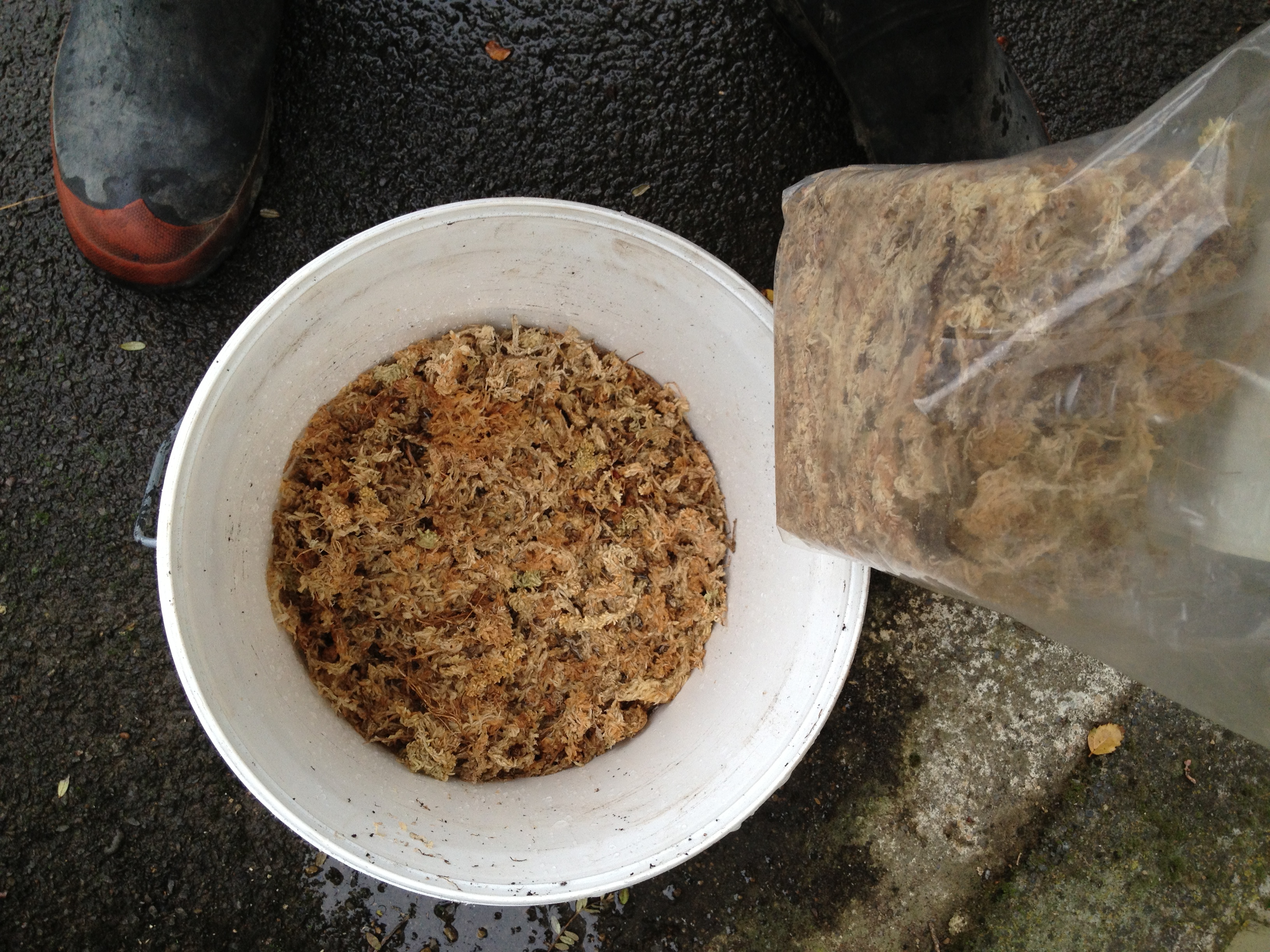
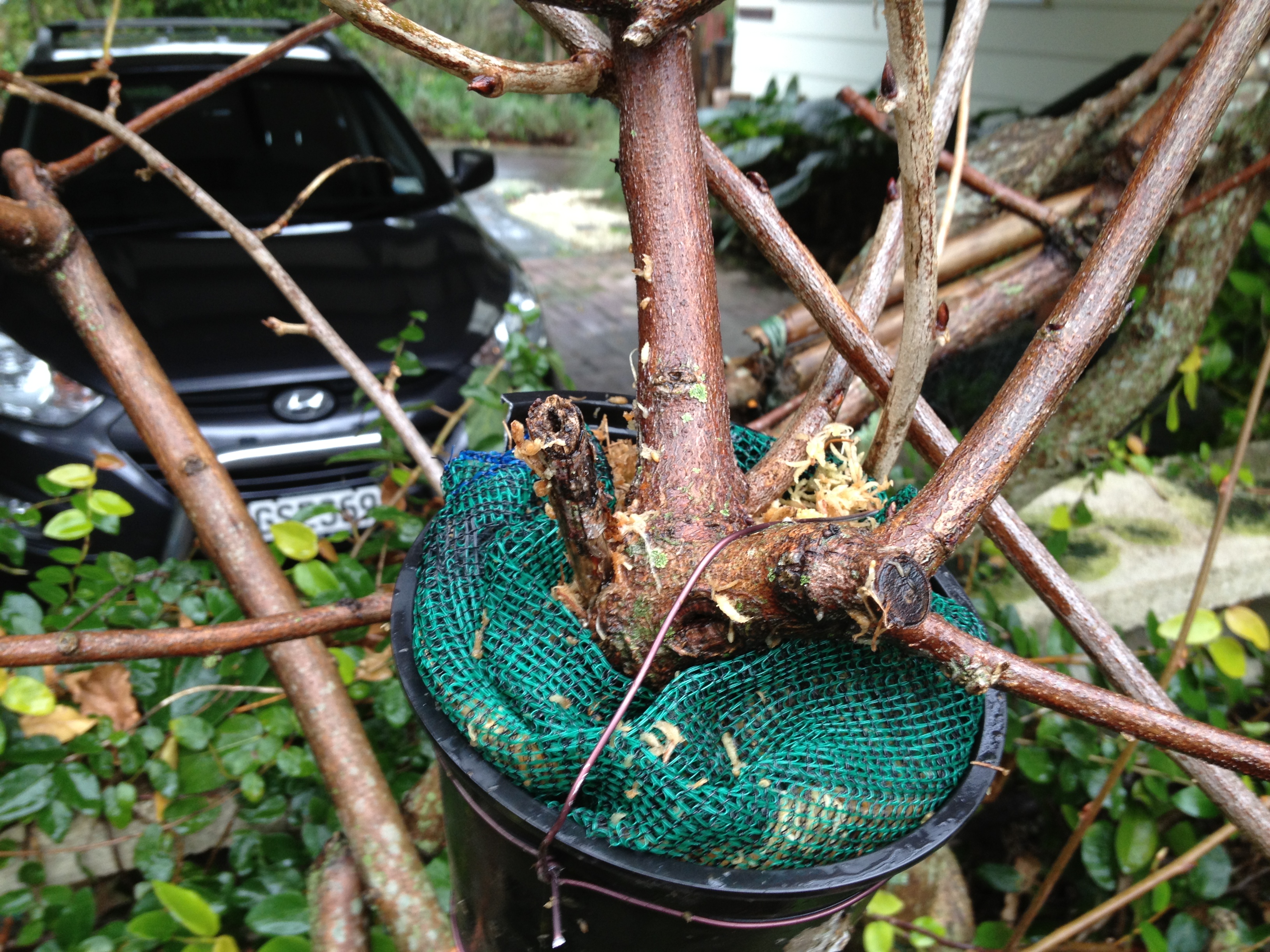
In Bonsai cultivation, Sphagnum moss is mostly used in conjunction with roots and root growing. It is a well-known fact that when trees are harvested from nature (Yamadori) that it is a good idea to pack wet sphagnum moss amongst the roots. The reason for this is obvious due to the water holding abilities of the moss. During a recent dig, I not only packed the moss amongst the roots, but also wrapped it in hessian before it went into a plastic bag for the trip home. This not only held the moss in place, but aided in keeping the moisture in. I am also at the moment experimenting with two similar trees, one with Sphagnum in the soil mix and the other with normal soil mix. The question to be answered is whether the one shows more and better root growth than the other one. More on the results in a future blog.

Two Olives

Sphagnum moss is also used for air-layering. Again the moss is tightly packed around the wound created for the purpose of providing a medium for root growth. The water-holding capacity is again the main reason for using the moss. In this case it also helps to allow air flow through the medium which will aid in root growth as well.

IMG_1287IMG_1292

The Bonsai Curriculum.

In the Bonsai Focus of September / October 2015 (136), Louis Bourdeau in an article titled “Silent communication”, mentions that the essence of Art is the use of raw material and the modification of it with the proper techniques to create an aesthetic creation. This is one of the better definitions or descriptions that I have come across thus far. My journey continues, but it will take take a lot to improve on Louis’ definition of the essence of srt.

As Bonsai artists, our raw material will always be the plant material that we work with. This is very different to any other art form where the raw material is not necessarily a living organism. Maybe body painting falls into this category as well. Other aspects of our raw material include the soil medium that is used as well as the pot. All of these aspects have their own dimensions and issues that must be thought about to bring about the desired aesthetic creation.

The next part of the definition is the reference to the proper techniques. This is where things become interesting. In all my years of teaching students the art of Bonsai, it is this part that for most, is the most intriguing. Maybe it is the use of tools or just the problem solving aspect, but I have yet to meet the student who does not want to learn more about the different techniques. These include things like wiring, potting or re-potting, bending branches, creating foliage pads, etc. Usually these are categorised as beginner techniques through to that of advanced or master techniques. It is interesting that it is done in this way as it probably fits the structure of apprenticeship quite well. 

I would like to argue that all techniques are equally important. It depends on the material that is in front of the artist. If bending of thicker branches are called for, then the artist will need to have mastered the correct technique for this. If we want to place techniques in a system of hierarchies from beginner to advanced levels, we will have to classify raw material as beginner to advanced as well. Seems a bit unfair on the beginner artist as he or she might be in posession of advanced material and will have no clue to proceed. How do we deal with this? This is probably where clubs come in. 

The next question then is whether we need a recognised curriculum to take club members through all the techniques, starting with the basics and going through to the advanced techniques. What happens when a club member joins three quarters through the curriculum and missed the early parts of the curriculum. Although this sounds like me just rambling along, I do think some thought needs to go into how we structure our teachings. Most Bonsai schools run different levels of classes to cater for the different expertise levels. These are run by professionals with the aim of making a living. This normally does not happen at club level.

In education there is a concept known as Differentiated Instruction. Roughly defined it means teaching towards meeting the needs of individual students. It means that you could have many different levels of expertise in your class, all with different needs, and you have to cater for that. What does this look like in a Bonsai Club or even a Bonsai School? The Japanese apprenticeship system is great, but it mostly relies on verbal communication or demonstrations to teach techniques. As said, nothing wrong with that and probably the best way to do it. Modern education do ask for structure and do ask for solid planning and execution during the teaching and learning process. This means curriculum. What would a Bonsai Curriculum look like? Food for thought.
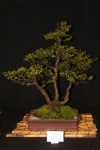
Back to Louis’ description – the end result is the creation of something that is aesthetically pleasing. What is needed to get to this point? That journey from starting with raw material to the end product, inclusive of all the techniques necessary to get there, is the Bonsai Curriculum. Techniques are not that difficult to describe, demonstarte and teach. What will have to be included in the Curriculum to teach the aesthetic part of our Art form? Much has been written about the aesthetics of Bonsai, but how is this taught and incorporated in a Curriculum?

Root development in Bonsai

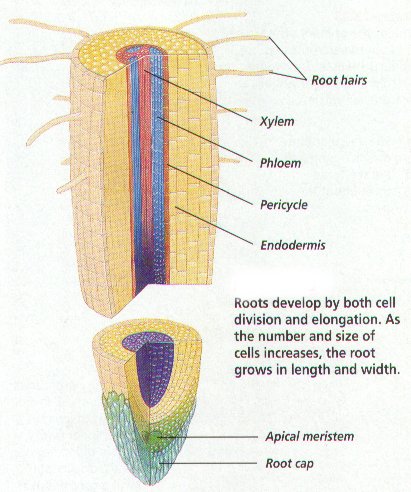
Tree_roots_cross_section-e1351581137309-1024x451It pays to know something about the anatomy and physiology of roots when it comes to developing the root system of Bonsai trees. It is said that a tree mimics its above ground growth to what happens with root growth below ground level. This might be true for trees in nature, but with Bonsai it could be quite different due to the fact that we prune the roots and the roots also have to grow in a confined space.

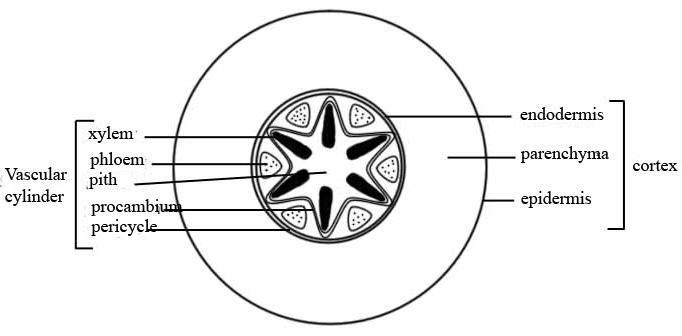
When a root is studied under a microscope it is clear that there partsofrootsare different tissue types present in different areas of the root. On the outside is an epidermis layer consisting of cells. To increase the surface area, and therefore the absorptive area of the root, extensions of these epidermal cells grow into the soil. These are the root hairs. The main job of the root hairs is to absorb water and nutrients. They are very small and fragile and normally breaks off when a plant is pulled from the soil. This is a very good reason to be gentle when a plant is uprooted and when soil is removed from the roots.Root(cross_section)

The next layer under the epidermis is the cortex. These cells are loosely spaced to allow for the movement of gasses and dissolved nutrients to the core of the root. The middle part (core or stele) of the root consists of the vascular tissues, the xylem and the phloem. The xylem particularly is of importance here as it is through this tissue that the water and nutrients are transported to the rest of the plant. Around the vascular tissue is another layer of cells, called the endodermis and underneath this is the pericycle.

OLYMPUS DIGITAL CAMERA

Lateral root growing from the pericycle.

This pericycle is of particular importance to the plant and Bonsai artists as this is where lateral roots originate from. The origin of the lateral roots is therefore situated deep inside the root structure and not like the branches or side shoots of the plant that originates from adventitious buds. The only reason for this that I can think of is that it provides better protection for the roots. It also means that the vascular tissue is in close contact with the lateral root.

repotting2

Apply rooting hormone to the cut roots.

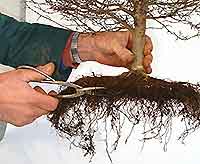
If the root is studied externally the branching of roots can be seen as starting a little bit further back up the root and not right from the root tip. The same mechanism that applies to pruning above ground is also evident here. When the apical meristem (in the root tip) is removed, the pericycle is stimulated to grow more roots. This is also due to the influence or the lack of this influence, of plant hormones. This is the science  behind root pruning. When a root is pruned, more roots will grow from that area. It will help if rooting hormone is applied to the cut area as this will help to stimulate the pericycle to produce more roots. Ensure that the rooting hormone is applied evenly for an even spread of new roots. There is some evidence that when the rooting hormone is applied to only one side of a root, that more new roots will grow on that side. I will experiment with this and report back on findings.

OLYMPUS DIGITAL CAMERA

Air pruning.

The term air pruning has also been used in the propagation of plants. This method can be used for Bonsai as well, especially during the early phases of development where the emphasis is on the development of branches as well as the root system. It simply means planting the tree in a container with holes in it. The roots will grow to the edge of the container and either split or not grow any further.

Well-DrainedSoilsIt was mentioned earlier that the removal of the root tip (apical meristem) will stimulate the pericycle to grow more roots. This is also true when the apical meristem is damaged. Growing the tree in a soil medium with lots of granular particles can cause the root tip to split or damage it and this will in turn stimulate more lateral roots to grow.

Also of note here is that the majority of water and nutrients are absorbed through the root hairs. As these are usually in the vicinity of the root tip (directly behind it), it can be taken for granted that these root hairs will be removed or reduced when root pruning. The uptake of water and nutrients will therefore be compromised when root pruning takes place. Be vigilant. This is the reason why the tree should be watered well and placed in the shade after root pruning. Water loss through transpiration must be avoided. Factors that increase transpiration are heat, wind and leaf surface area. It is therefore a good idea to reduce the leaves after root pruning in the case of deciduous trees. This might be another reason for re-potting and root pruning in spring before the leaves are fully grown.

938277CE-FFB2-4BE6-B1C5-98D83AA77553As roots age, they undergo secondary growth or secondary thickening. This is basically when the softer tissue becomes woody and bark is formed. This happens faster with exposed roots. The main thing to remember here is that older roots that have gone through this process will not absorb water and nutrients. When root pruning, this needs to be taken into consideration. Always leave some of the younger, finer roots to provide the plant with water and nutrients.

Mycorrhizal fungus – Root friends

mycorrhizae-fungi

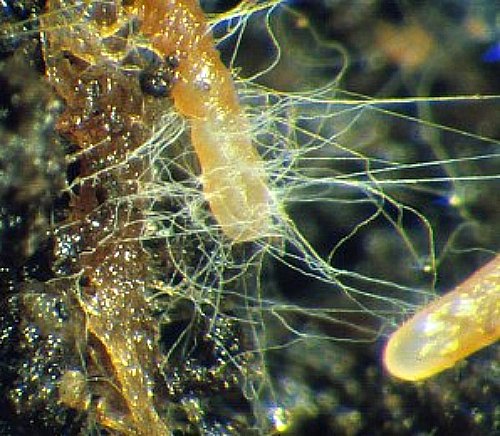
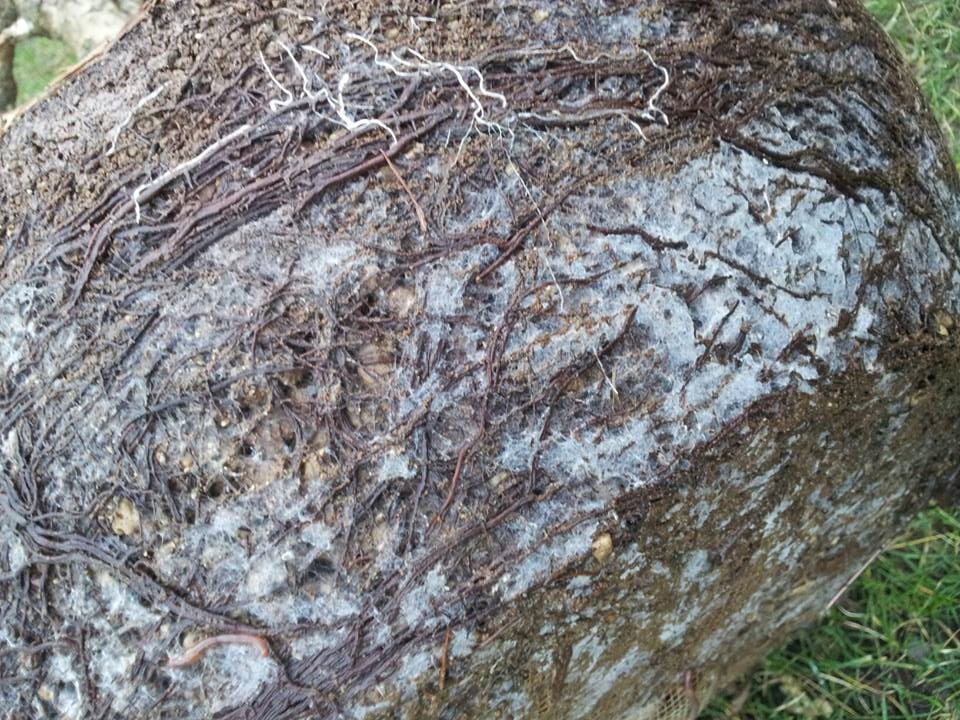
The white threads are Michorrizal fungi.

Mycorrhizal fungi occurs naturally in soil. They form a close symbiotic relationship with plant roots. They are called mycorrhizae ,from the Greek “mukés”, meaning fungus, and “rhiza,” meaning roots. Mycorrhizae are considered to be in a mutualistic relationship because both organisms benefit. The fungus receives the products of photosynthesis from the plant and is therefore does not need to find its own sources of energy. At the same time the fungus grows out into the soil and retrieves nutrients, especially phosphorus and nitrogen, and passes these back to the plant. It is usually seen as a network a very thin, white threads spread throughout the soil in close contact with roots.

mycorhizes

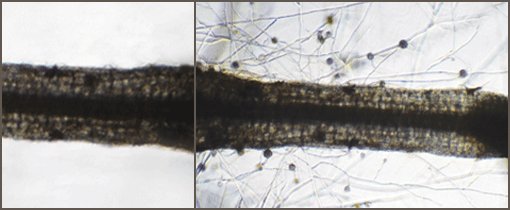
The root on the right has the fungus in close contact to enhance the absorptive area of the root. This means more nutrients and water can be absorbed than the root on the left.

However, in most soils that have been disturbed by residential construction, or intensive cropping practices with applications of fertilizers containing pesticides and other chemical products, the mycorrhizae content has considerably diminished, and has become insufficient to significantly enhance plant growth. Numerous experiments have shown that plants without mycorrhizae cannot cope as well with low mineral levels as those that have mycorrhizae.

larix-michorriza

In a Bonsai pot, the soil is a very controlled environment. The Bonsai artist determines what goes into the soil, what it consists of and how much water is given.

When mycorrhizal fungi colonize the plant’s root system, they create a network that increases the plant’s capacity to absorb more water and nutrients such as phosphorus, copper and zinc. This process in turn enhances growth and favors rapid development of roots and plants. Where this fungus is present in soil, a much faster establishment rate of new roots is observed as well as a reduced water need of up to 30%. The reason for this is that the micorrhizae ensures a much larger surface area is available for the absorption of water and nutrients. The plants are healthier and grow faster.

There is also evidence that these fungi can also improve the structure of the soil. The threads grow through the growing medium and aggregates the soil. This allows for more air to move through the soil as well as enhancing drainage.

Back to Bonsai cultivation. As mentioned before, the soil in a Bonsai pot can be very sterile as it could consist of particles that do not necessarily contain living organisms or lots of organic matter. These could include valuable soil bacteria (nitrogen fixing bacteria) as well as michorrizal fungus. In the absence of these, it is important that the Bonsai artist allows for modsc_1936re (more frequent) fertilization to take place. Michorrizal fungus spores can be bought (I have not seen it in New Zealand yet), but a much less expensive way to inoculate your Bonsai soil with the spores is to use a bit of the original soil in the Bonsai pot at planting time. I find that this is especially important when I plant Pines and other conifers.
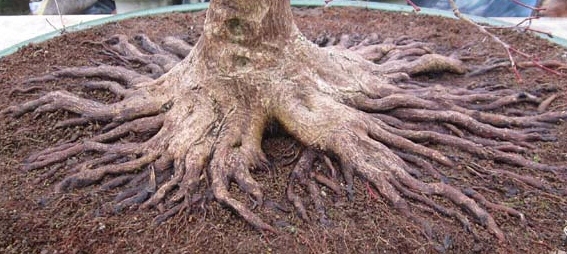
In summary: Most plants in nature live in a relationship with Micorrhizal fungi. Both organisms benefit from this relationship. Most Bonsai soils will not contain this fungus and by adding the fungus to Bonsai soil, the plant will establish faster, take up more nutrients and will need less water. Something to think about when it comes to transplanting time.

Nebari – The Root of the Matter

938277CE-FFB2-4BE6-B1C5-98D83AA77553

These roots have grown over time, dropping of the side of a cliff.

No, we are not talking about the Nebari fictional alien race from the planet Farscape, but the Japanese term generally used to indicate the roots and specifically the root flare at the bottom of the trunk where the root region starts. It also indicates the visible surface roots.

Wikipedia refers to it as: “Also known as “buttressing”, nebari is the visible spread of roots above the growing medium at the base of a bonsai. Nebari help a bonsai seem grounded and well-anchored and make it look mature, akin to a full-sized tree.”

img_1634

My idea is to write three or so Blogs focusing on Nebari and the development of roots. There is no doubt in any Bonsai artist’s mind that the roots of a plant is where it all starts. Healthy roots = healthy plant (generally). A plant absorbs most of its water and nutrients from the soil through the roots. We therefore have to know something about soil and its water retention and draining properties. Not all soils are created equally. We also need to know something about the physiology and anatomy of roots. This knowledge will help us to understand many of the concepts around root pruning. This will come in later Blogs.

Autumn bonsai images 2014 (17)

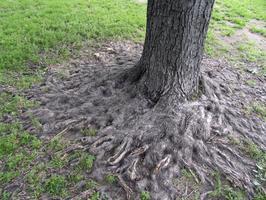
A tree growing in a woodland area. These roots definitely add to the character of the tree and indicate that it has been there for a while.

Getting back to the Nebari, the main aim of establishing a root flair at the base of a tree is to indicate age. A wider base caused by a flaring just above the roots, helps to establish the taper of a tree. One way to develop taper is to increase the circumference of the tree at the base and to keep the top of the tree relatively thin. Young trees do not have a huge flair at the base, but older trees show this without fail. In saying that, there are trees that are used for Bonsai that do not show a big root flare. Junipers come to mind here.

root310

The roots are spread over a flat surface and tied to this surface.

There are multiple methods to improve the Nebari of a Bonsai tree. The first one is the continuous root pruning of downwards growing roots. For the health of the tree it is advised that this is done over time to enable the tree to grow new roots in the place of the removed roots. A second method is done through air layering. This is simply done through preparing the bottom of the trunk as one would for air layering and heaping up the soil or packing sphagnum moss around this area. Roots will over time establish themselves in that area. I have read about a method where a wire is bound tightly around the trunk just above the roots. The flow of nutrients will be impeded and that will cause new roots to grow from above the wire. I have not tried this method myself before and cannot comment on how successful it is. Other methods include drilling holes through flat tiles and tying the roots of the tree in a horizontal direction to the tile with wire through the drilled holes. It could also be done through grafting.

In the end, the Nebari plays a vital role in the aesthetics of the tree. It is crucial thfotolia_2553306_XSat some sort of Nebari be established as it indicates age, shows that the tree is balanced and sturdy and has been there for a long time.
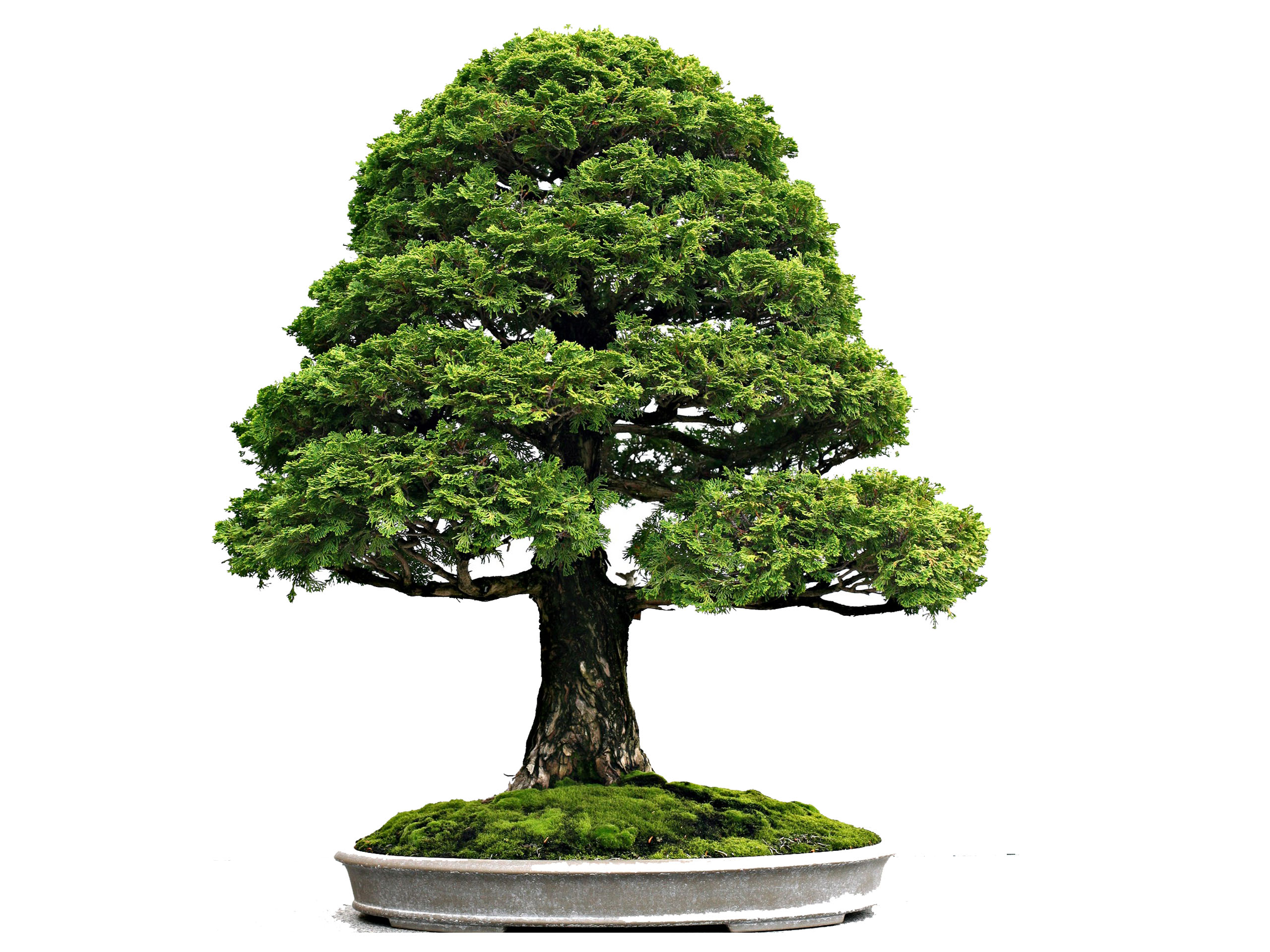
The next Blog will address the science behind root development.

Movement and Flow in Bonsai

Let us first define the two concepts to ensure that we are all on the same page during this discussion. Movement is what physically happens with the trunk and branches. In other words, whether the trunk moves to the left or to the right or in an S-shape to both sides alternatively. Flow is the general direction that the tree leads the eye towards. There are a few things that determine this flow.

bonsai_wallpapers-17

A formal upright tree does not necessarily show flow as the idea here is that the tree is symmetrical and well balanced.

Most sources recognise that it is the first or primary branch as

Homemade Bonsai

The primary branch’s movement is towards the right and the apex is also in that direction. Overall flow therefore is to the right. It can also be seen that the tree is planted towards the left of the mid-line of the pot.

well as the apex that determines the flow direction. I would like to add the trunk line to this as well. Although the trunk could be leaning towards the left, the primary branch could be moving to the right and the apex could be on that side as well. Overall the flow will be to the right. All the other branches and in some cases the nebari, will have to be designed to follow this flow pattern.  What if this does not happen? The main issue will be that the tree will look unbalanced and disturbing to the eye.

sample bonsai

This is an example of a tree with flow in all directions. The trunk on the right flows to the left, the trunk on the left, flows to the right.

Flow is important as it will determine the placement of the tree in the pot. Trees should be potted behind the mid-line of the pot, but the flow will determine whether it is planted to the left or right of the mid-line. As said, it comes down to the flow. If the flow is towards the left, the tree will be planted to the right of the mid-line. If the flow is to the right, the tree will be planted to the left of the mid-line.

bonsai-17

The primary branch is towards the right, so is the apex and therefore the overall flow is to the right. The tree is therefore planted towards the left of the mid-line.


014

This tree has its primary branch moving to the left and the apex is on that side as well. The trunk is also slanting that way which makes it easy to determine that the overall flow is towards the left.

The display of the tree is also determined by the flow. The placement of the companion plant (kusamono) will be on the side of the flow direction. For example, if the flow is to the right, the kusamono will be placed on the right. This becomes very important when shohin are displayed in a multi-tiered stand. Trees should either be all adding to wards the overall flow of the whole display, or they should complement each other by forming a “closed” display. This means that they do face each other within the display. It all depends on the effect that the artist wants to create.

display-10

The main tree shows its flow to the left and the companion tree shows its flow to the right. These two trees complement each other.


1078632432_2rHzx-S

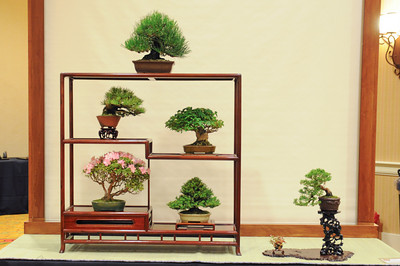
In this shohin display the top tree is balanced with no overall flow. The next shelf down shows the tree on the left with its flow to the right and the opposite is true for the tree on the right. On the bottom shelf, the tree on the left flows to the right, the tree on the right looks relatively balanced and if anything, the primary branch could be moving to the right. In this case the companion plant to the right of the display, flows to the left. A well-balanced display.

The principle of flow and the calming effect that it can have on the observer cannot be underestimated. It is the same when one looks at a masterpiece painting. There is always some sort of flow to be seen. This is either in a specific direction (see kusamono placement above) or it is towards a focal point within the artwork (see shohin display above). This principle can therefore be seen as a wider artistic principle and not only applicable to Bonsai. For me it also has to do with the flow of energy. The overall flow of the tree indicates a flow of energy. This adds to the dynamic nature of a display or to a more relaxed feel. Where there is flow in too many different directions, the energy flow is all over the place which adds to a feeling of discomfort when observing the display.

References:

I would like to acknowledge the websites that the photos came from as used in this blog post.

http://michianabonsai.club/sample%20bonsai.jpg

https://sanaakosirickylee.files.wordpress.com/2012/05/bonsai-17.jpg

https://encrypted-tbn3.gstatic.com/images?q=tbn:ANd9GcS9a_9UTyb_T8ZVzWH445ALrtjodYvDzxgwOtL3JN6aJAsICNlD

https://encrypted-tbn0.gstatic.com/images?q=tbn:ANd9GcSIAPeSEvPE8vsZk9tD36gsAcAQQR_Ee7UPYtL0bwceqOcqU9KP

http://dupuich.smugmug.com/Bonsai/Exhibits/GSBF-XXXIII-Convention-Exhibit/DSC0047/1078632432_2rHzx-S.jpg

http://bonsaitonight.files.wordpress.com/2009/05/display-10.jpg

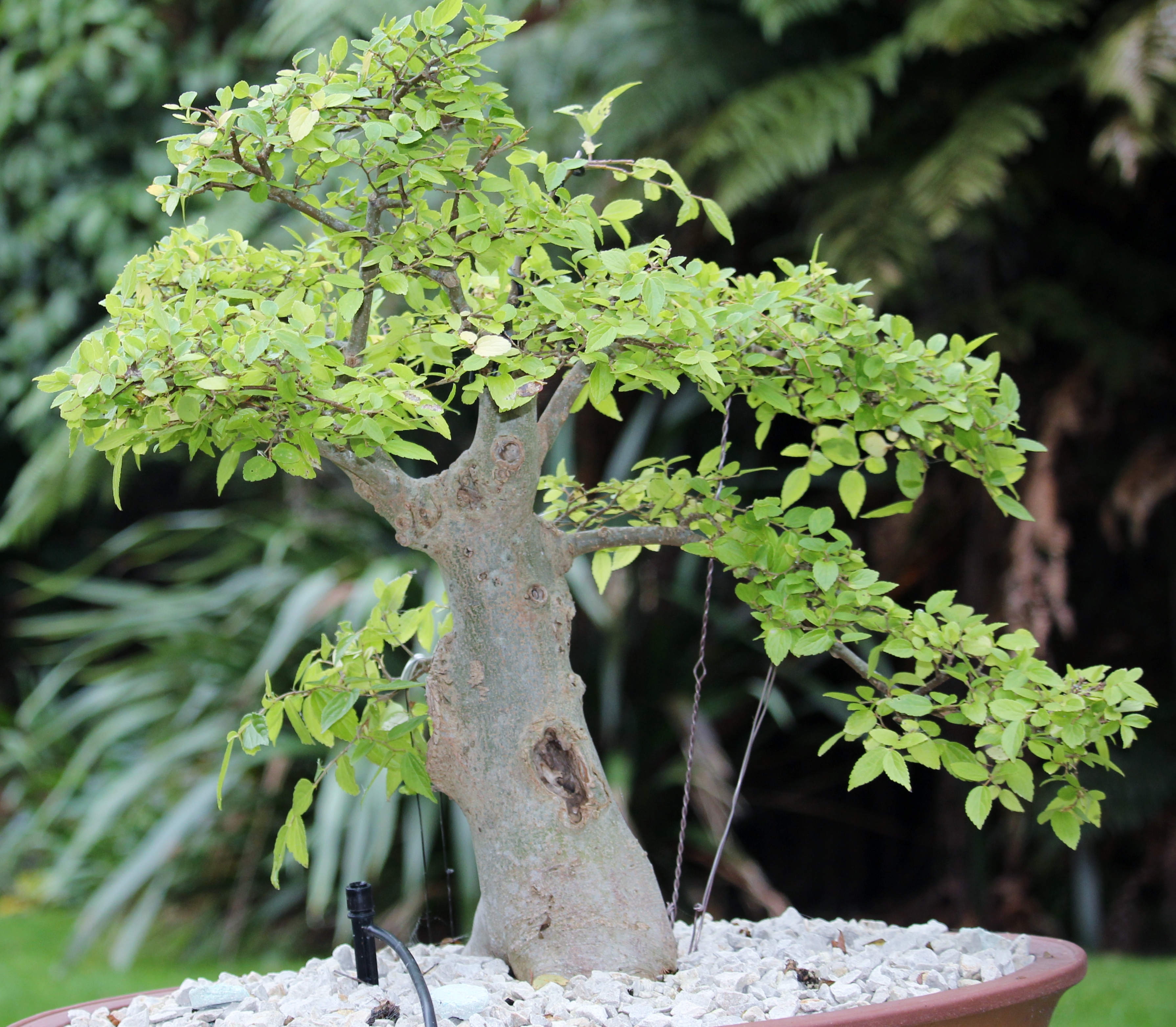
Siberian Elm – Ulmus pumila

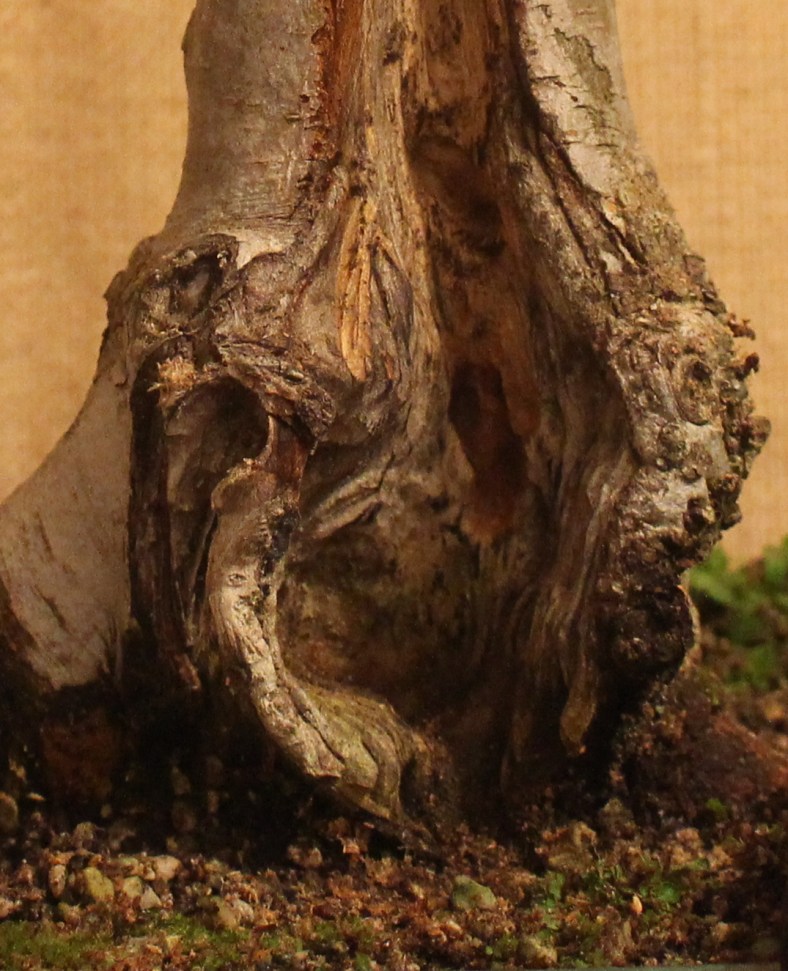
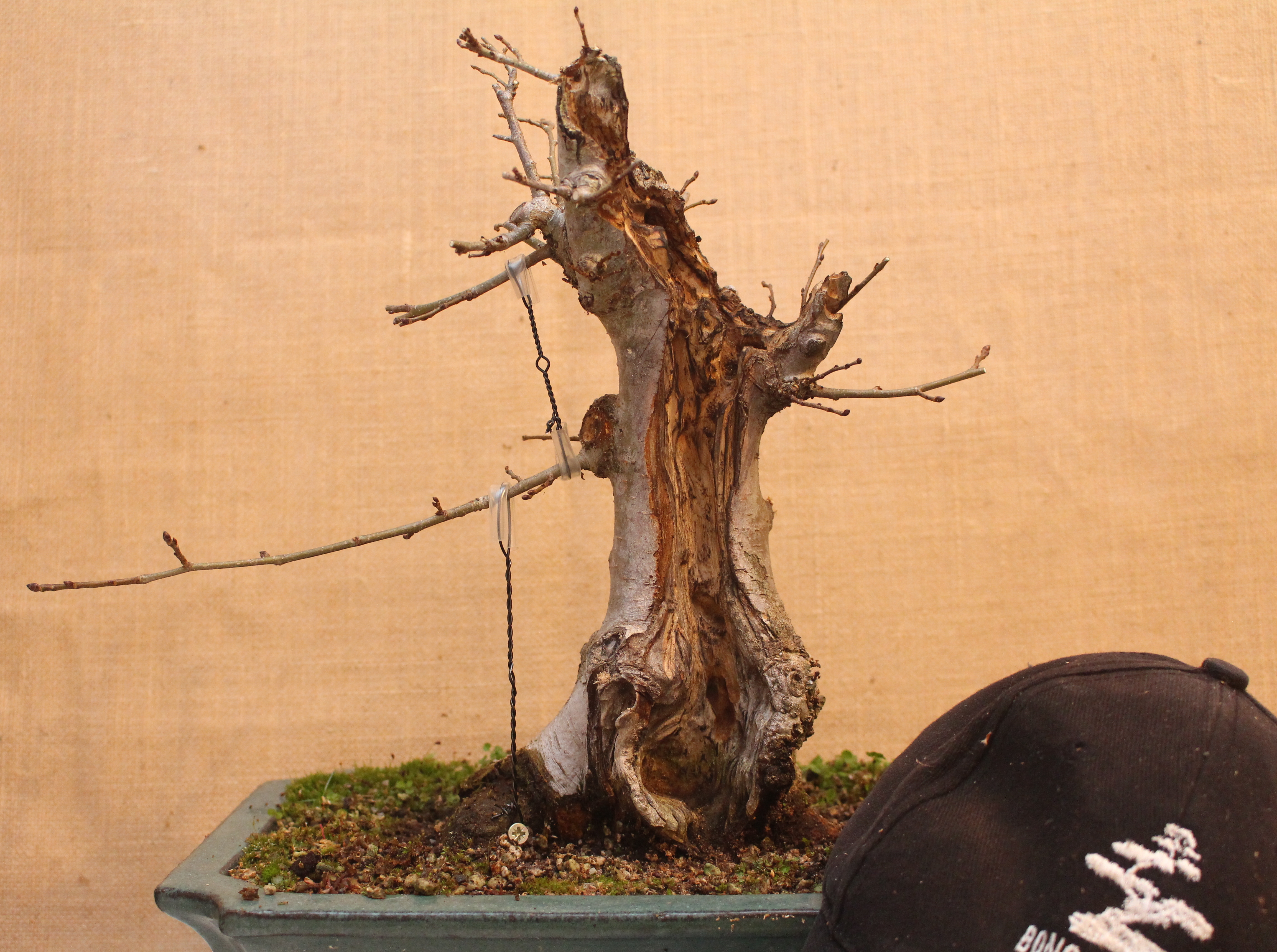
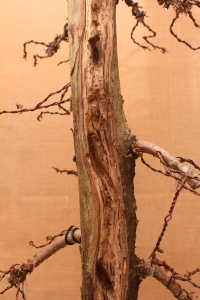
This little Elm had a huge ugly cut right at soil level when it came IMG_2951into my possession a year and a half ago. This was carved quite deeply to get rid of and then it was extended upwards to try and get a more natural look. The carving was further worked on today. The large carving at the bottom has weathered well and the shari extending upwards from here was made deeper as well as fine carved with a Dremel. A small carving was done on the back where another large (not as large as the front one) cut was made. This resulted in a hole now going through from the back to the front. It is quite high up near the apex.IMG_2953
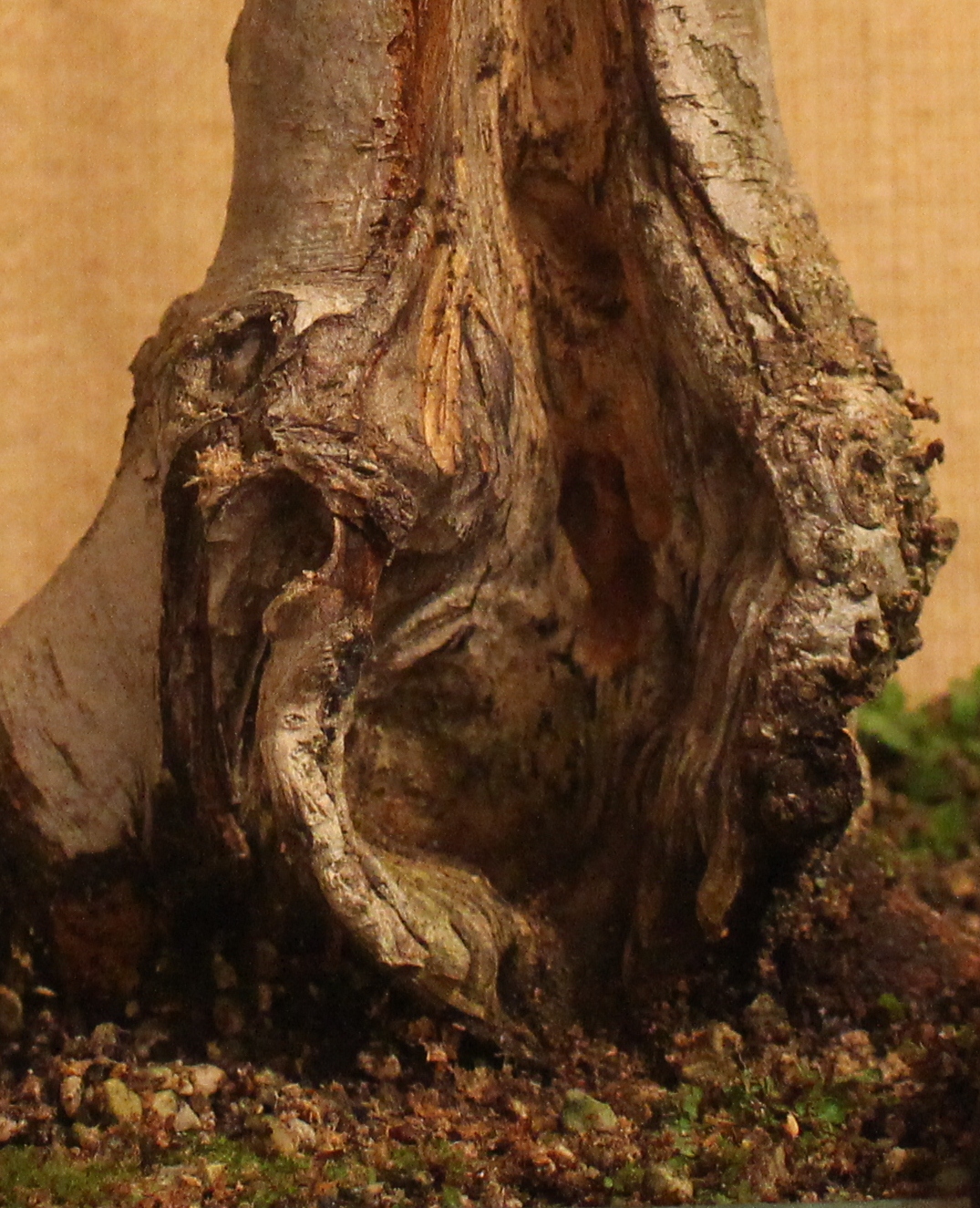
The leaves have now all dropped and it was decided to work on the carving a bit more and then to also pull the branches on the left down a bit. The flow is to the left. The branches on the right will be kept short and at the next repotting, the tree will be slanted to the left slightly and it is leaning to far forward at the moment.

I have not seen too many of these around and treat it as I would any other Elm. The leaves are still very large and with proper pruning it will hopefully get smaller. The bottom left branch will also be left to grow as it needs to get some width on it.IMG_2956

Swamp Cypress – Taxodium distichum

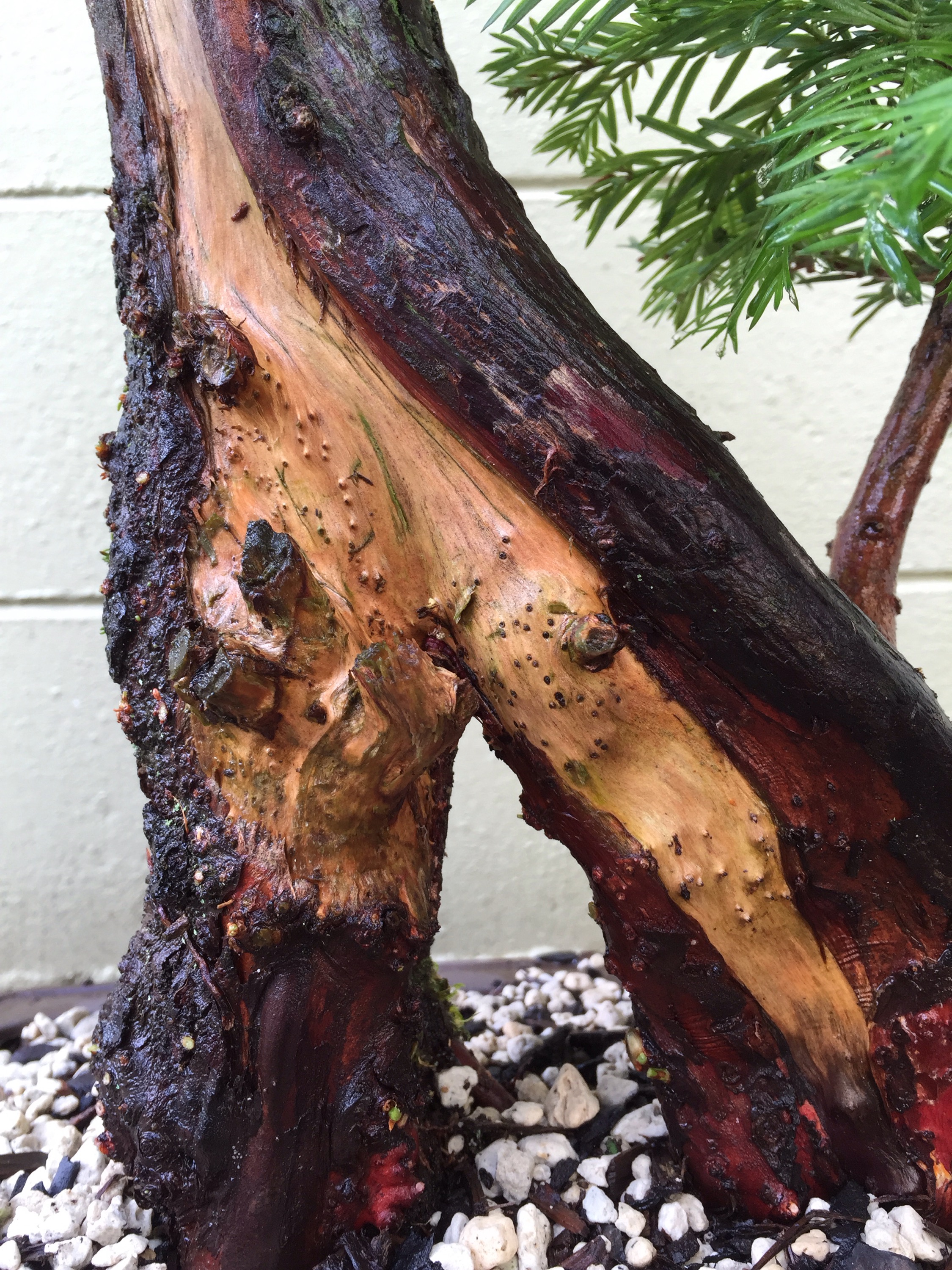
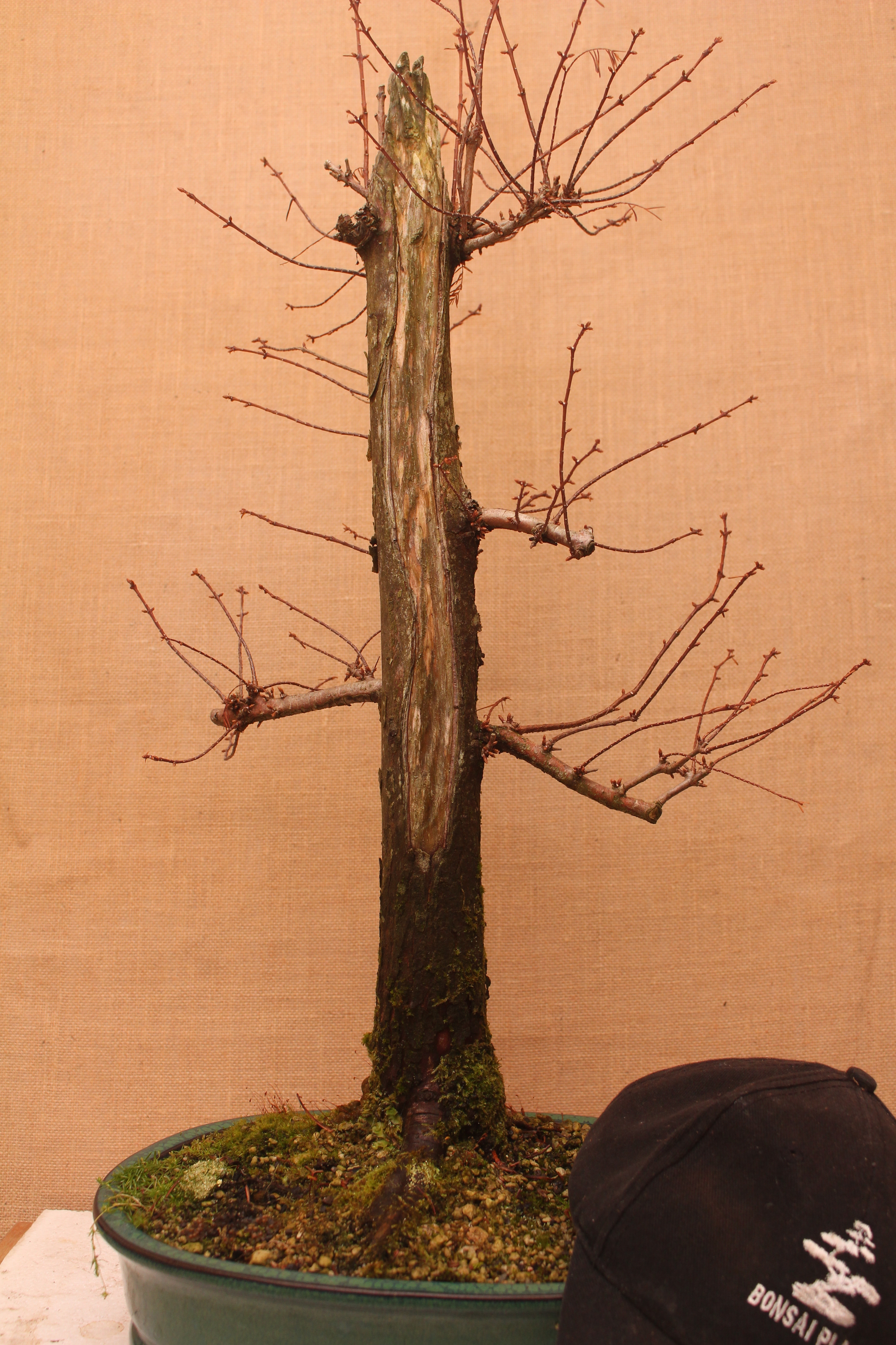
IMG_2943Two years ago this was a two and a half meter nursery tree. I chopped it down to about a meter at the nursery as I could not get it in my car. Then the journey began. It was potted in a Bonsai pot and left to grow, It had a light prune and a bit of a carve a year before and today it was time to revisit the shari and to get some wiring done. The buds are very fragile this time of year and great care has to be taken to not break them off.

The carving wasIMG_2945 done first. The original carving was done with very rudimentary tools. I now have a rotary carver as well as a router that I use for carving. I went deeper today and added a bit more detail to the top. Out came the burner to get rid of all the frilly bits. The bark and branches were protected by aluminium foil. It was finished off with a wire and then a nylon brush.
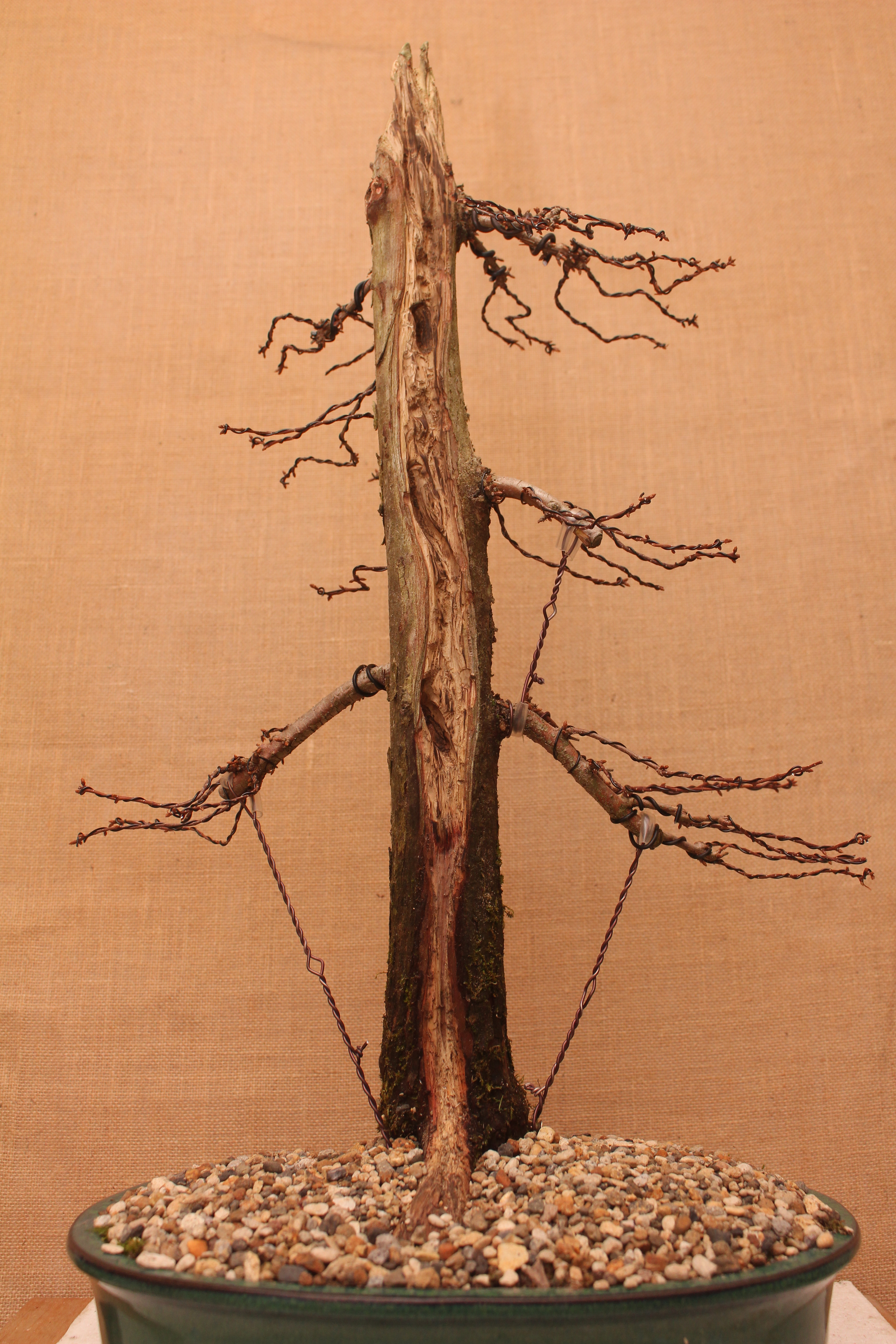
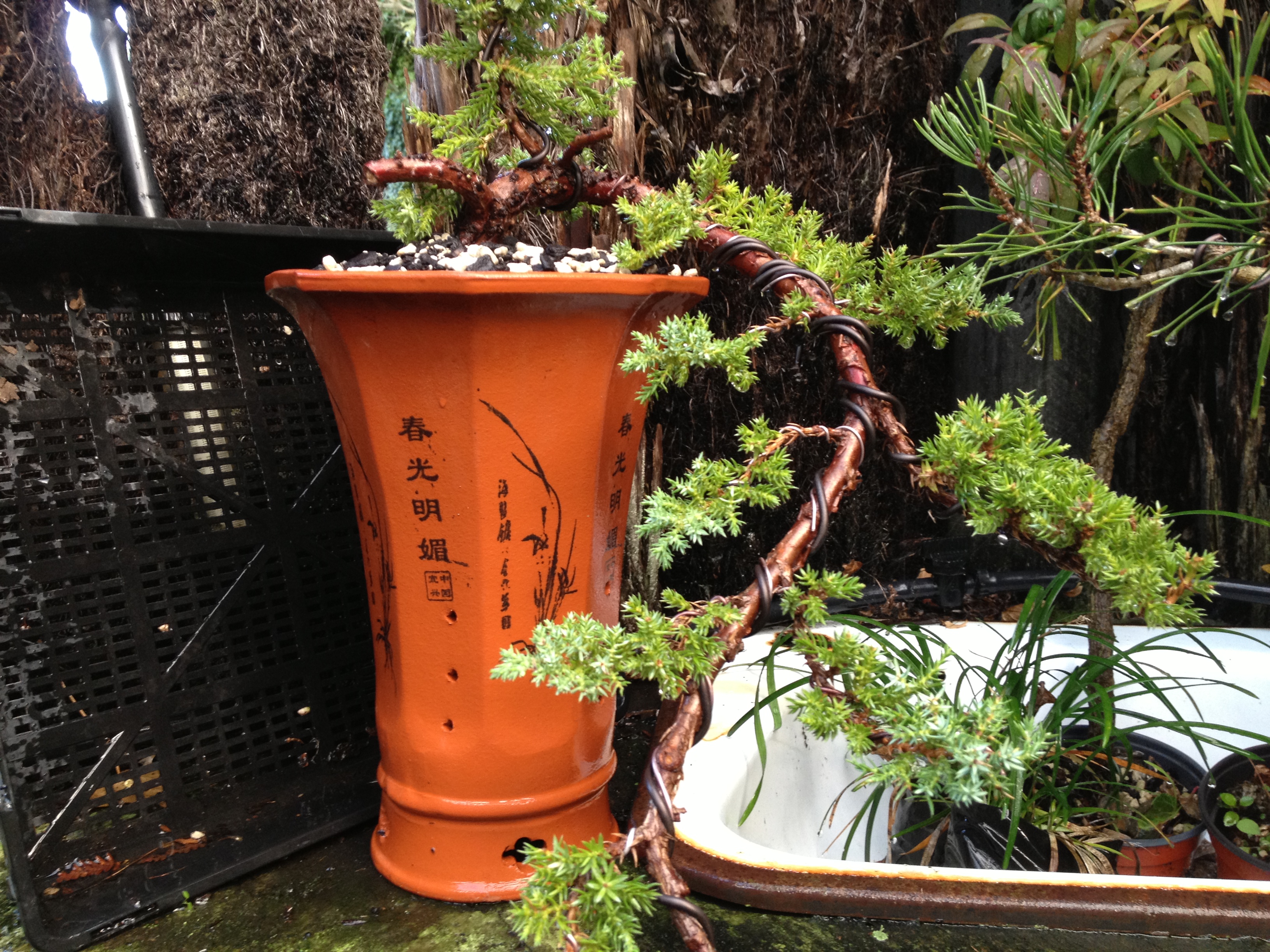
I used guy wires to pull the thicker branched down and then used 1 mm wire to wire and place the thinner branches. Now it has to rest and grow when Spring comes around again. I will also have to repot at a better time as I discovered that the soil was very wet. It is Winter in New Zealand now and it has been raining non-stop over the last 48 hours. These trees prefer a bit of a wetter soil, but this is just too wet at the moment.IMG_2947

This is a very easy tree to grow and it buds profusely in spring and carry on with this almost right through Summer. There are gaps on the left hand side that must be filled. I will keep an eye on any buds forming in that area like an expectant father. The top branches also must be shortened, but I will leave it as is for now as I need more buds and growth in that area to replace some of the existing branches. It has a soft foliage and contrasts well with other trees as the leaves are a very light green. These turn yellow-brown in Autumn.

Creativity and Bonsai

rs2

Tree by Robert Steven

There is no doubt that Bonsai is a Creative Art form. Once the horticultural needs of the plant is met, the creative and art side of Bonsai kicks in. In thinking about this concept of creativity and how it applies to Bonsai, I had a lateral thought moment that it is not dissimilar to what Maslow proposed as the hierarchical needs of human beings. The major difference is that we do not work with an organism that can think when it comes to Bonsai. The lowest level of needs around the Biological and Physiological must be met for the tree to stay alive and the next levels applies to us and not the tree. Higher levels of Maslow’s theory do refer to the need for creativity and maybe through that, a level of self-actualisation for us as humans. There is a need for us to be creative. Not all of us are in touch with our creative sides. Mine came late. I realised that I could grow things, that I am good at educating people and once I was exposed to the Art of Bonsai, I found an area where I could feed this need to be creative and become involved in another where I could educate and be educated.

lindsey-bebb

Trees by Lindsey Bebb

What is creativity? I have consulted the writings of some of the gurus on this topic and came up with the following:

  • It is the process of having original ideas that have value – Sir Ken Robinson.
  • The phenomenon whereby something new is created which has some kind of value – Wikipedia (probably not a guru).
  • Micheal Gelb suggests that for original ideas to provide value, they must be translated into action. He also refers to the term “creative energy”.
kimura

Trees by Masahiko Kimura

How can we apply this to Bonsai? I see three movements in the Bonsai world. The one is the creation of Penjing – landscape scenes mainly out of China. Another one is the following of the rules and “laws” of the traditional Japanese style and the third one, which is growing rapidly throughout the West, a more informal, creative style. Whatever path you take, creativity is needed to pursue it successfully. Sir Ken Robinson’s idea of having original ideas probably leans itself more to the more informal style as one is not necessarily bound by the “rules”. Although I have made a thorough study of both Penjing and traditional Bonsai, I find that I do lean towards a more informal, creative style. Why? It could be that it suits my way of thinking or it could be that the material I have available to work with, leans itself more towards it. The New Zealand Bonsai scene is relatively young compared to the rest of the world and we are bound by regulations through which we cannot import trees and have to rely on what is already here and then work according to what these trees allow us to do.

john-naka

Trees by John Naka

Is this a problem? No, I do not think so. I just had the privilege of helping to select the trees that will be on display at the National Convention later this year in Christchurch. The trees put forward for selection are of good quality and very dissimilar to each other. The variety tells me that there is a creative spirit or energy (Gelb) present. The lesson that I get out of this is that once we throw the shackles of conformity and “rules” off, creativity is enhanced.

ben-oki-11

Trees by Ben Oki

This is seen throughout the world. I am not saying that the rules and the foundations of Bonsai must be thrown away, what I am saying is that it is clear that where people have the opportunity to be more creative through what the tree allows us to do, the results are as spectacular as when we follow the traditional rules. It is fascinating watching our best Bonsai creators in action and studying their creations. Even the ones with a thorough traditional Japanese grounding show that you have to respect the tree and when we especially work with wild harvested material (Yamadori), the tree’s history must be respected in the design.

What does this mean for our creativity? You have to let the tree lead you, but within that you still have options. Some of these options will include the following of traditional “rules”, but where the tree does not allow this, one will have to apply original ideas (back to Sir Ken) and if this leads to a well-designed Bonsai tree, then creativity is seen in action. It has value as it has added to a body of knowledge, ideas and even new techniques that could be used in future. I can use the composition of Music as an example. The composer needs knowledge, technique and an open mind to compose. The composer would have studied Music, played it, composed it, made mistakes and would have experienced success. The same is valid for Bonsai creation.

Study what is available, practice a lot, work on minor trees and work on superior material as well, but above all, ensure that you have an open mind. What does the tree allow you to do? How do you use that to create beauty? Do you have original ideas? Do you add value?

My last thought for today: Look outside of Bonsai for inspiration. Read and use You Tube to learn about other creative pursuits and let these inspire you to be even more creative.

References:

Creativity on demand by Michael J. Gelb. A great read for general creative inspiration.

Creative Schools by Sir Ken Robinson. I am an education leader (something has to pay for my Bonsai addiction) and find that I can apply ideas from all over to my recreational and creative pursuits.

Wikipedia. It always gives me a heads-up when I start to wonder about things.

The photos on this page ashamedly (on my part) comes from this website: http://webecoist.momtastic.com/2009/06/09/tree-art-6-amazingly-creative-bonsai-artists/

I apologise if I have broken rules to use them here, but all I am trying to do is to promote Bonsai in general and certainly not for my own gain.

image

Liverwort and Bonsai

IMG_0035Liverworts are flat growing green plants, closely related to mosses (Bryophytes). They have no stem and only a thallus, the flat leaf-like structure that is seen above ground. They belong to group called Hepatics and belong to the Marchantiophyta, a division of bryophyte plants, the mosses. These plants are primitive, not only in structure, but also in the fact that they are old. Some sources mention that they transition onto land during the Devonian Era (400 million years ago). Goes well with Bonsai then, I hear you say. Not really.

Bonsai growers will find these plants in moist areas. Where I live we have a high rainfall in winter and I have to be very careful with watering. This is usually taken care of by ensuring that the soil medium is free draining. Most of the liverworts that I see growing on soil come from nursery sourced plants, probably because the soil contains the spores and the fact there could be lot more organic soil in nursery plant soils.IMG_0032

The problem for me is that they can rapidly cover the surface of the soil and prevent water from penetrating the soil. This is not necessarily a problem as they already indicate that the soil is too wet. This layer of Liverwort can also prevent proper air circulation through the soil. I have also had experience of Liverwort growing over moss (I want the moss), suffocating the moss to death.

IMG_0034These plants reproduce asexually and sexually. They produce bumps (cupules) on the leaves, usually during late autumn, containing “eggs” called gemmae. These produce new plants. The sexual reproduction produces spores which germinate and form new plants.

As said, these plants can be an indicator that your soil or growing medium is too wet. If this is the case, it is obvious that the medium must be changed to be more free draining. Larger inorganic particles can be used to do this. If it is still a problem, look at the top layer of the soil. This could contain spores of liverwort. Scrape the top layer off and replace with a coarse material like gravel or pea metal.IMG_0035

Harsh chemicals could be used to spray on the liverwort to kill them off, but I have found that dabbing or brushing vinegar on the leaves of the liverwort, kills them off as well.

References:

http://www.backyardnature.net/liverwrt.htm

http://www.kiwicare.co.nz/help/problem/?sid=liverwort

Ian Sayer – Bonsai artist.

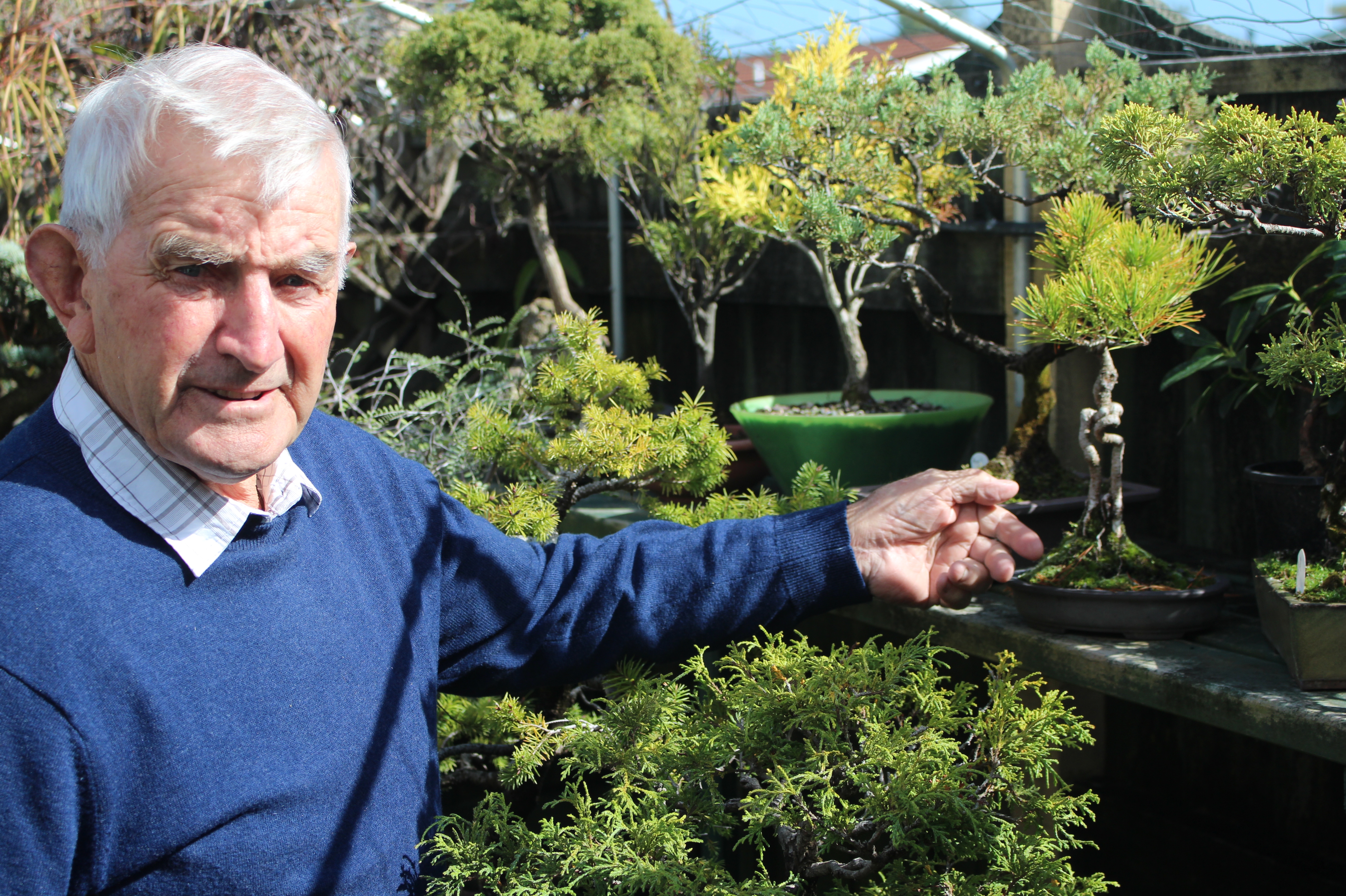
Ian Sayer 002I visited Ian Sayer recently to talk to him about his experiences and journey with Bonsai. Ian started his interest in 1991 through Malcolm Potts. He was at the time building a house in Taupo and stopped for tea where he saw some small Kahikatea trees and brought them home. During that time Ian was involved in Scouting and also had other interests, but Malcolm’s trees won him over. He can still remember attending his first Bonsai meetings in his scout uniform as they took place on the same night. His only regret, like most of us, is that he wished that he started twenty years earlier.

Ian Sayer 011Ian also mentions the name of Bob Langholm, a person that he was very impressed with and who influenced him positively in his pursuit of Bonsai. He went to the conference in Matamata in 1992 and met Bob for a second time. Ian also loved going to the National Conferences as he not only learnt a lot, he enjoyed the fellowship around the Bonsai trees. The demonstrations are highlights for him as it helps to broaden his own perspectives. An interesting fact is that he never showed any of his trees nationally as he found the transporting aspect quite hard on the trees. He has however no problem with showing his trees locally in the Hawke’s Bay and love hosting guests to see his collection at home.

Ian Sayer 013Ian prefers to work with Kowhai and Junipers. He loves Pines and says that they are very forgiving and that they can take a lot of punishment. He collected most of his Pines from the Napier – Taupo road. One of his tips during the visit was to always leave a tree collected from high altitude for at least a year, but preferably two alone before you start to design it.

Ian Sayer 017He is passionate about his local club and has served 14 years as Secretary of the Hawke’s Bay Bonsai Club. Ian took a short break from his secretarial duties, but is now back in the saddle. He loves doing demonstrations. He believes in a simple mantra which is: Show people what to do, teach them individually and then let them do it for themselves.

Ian Sayer 050Ian is also a potter. He makes his own pots and has been doing so for years. At the time of the visit he had quite a few decent sized pots in an oven.
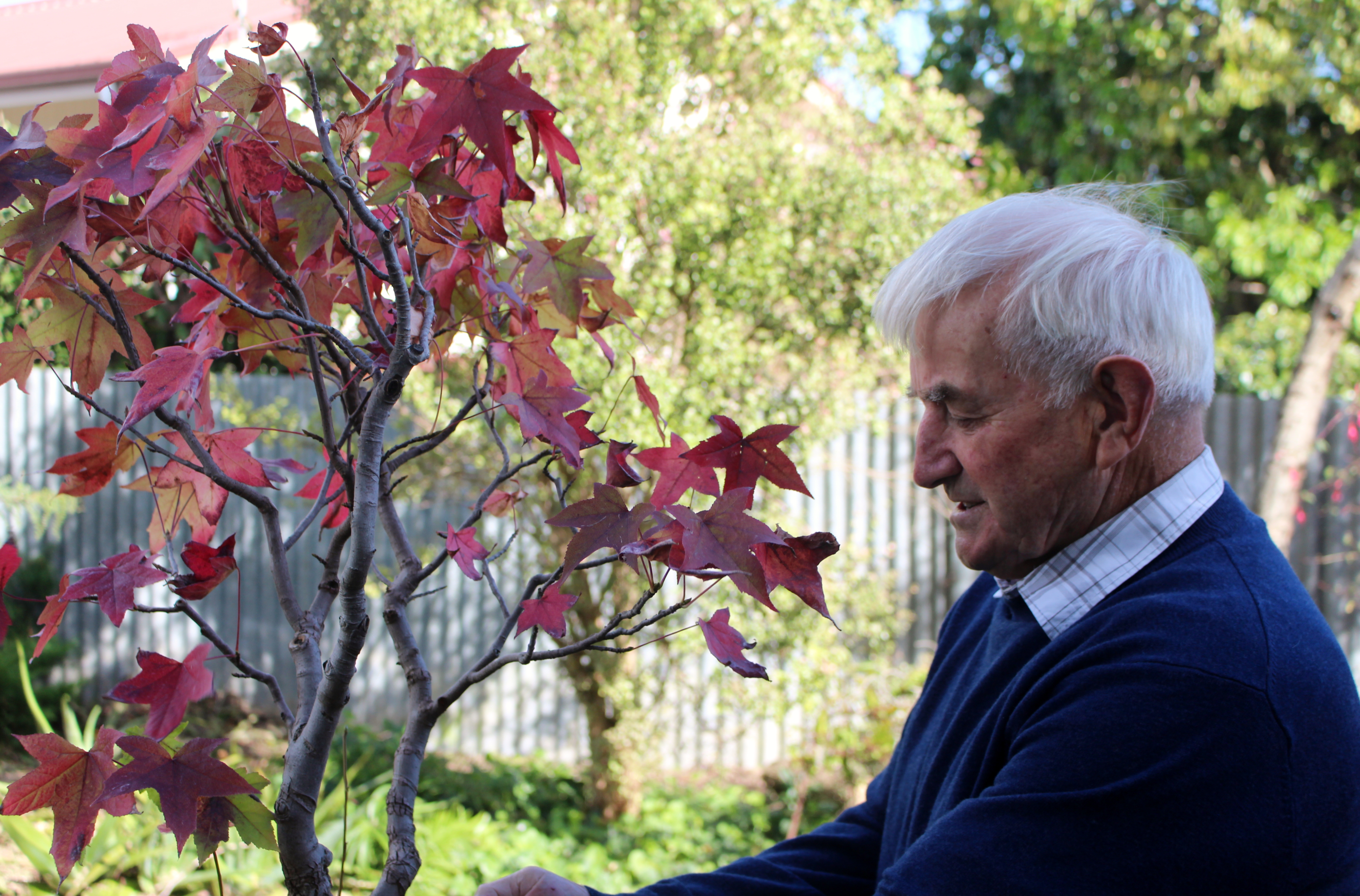
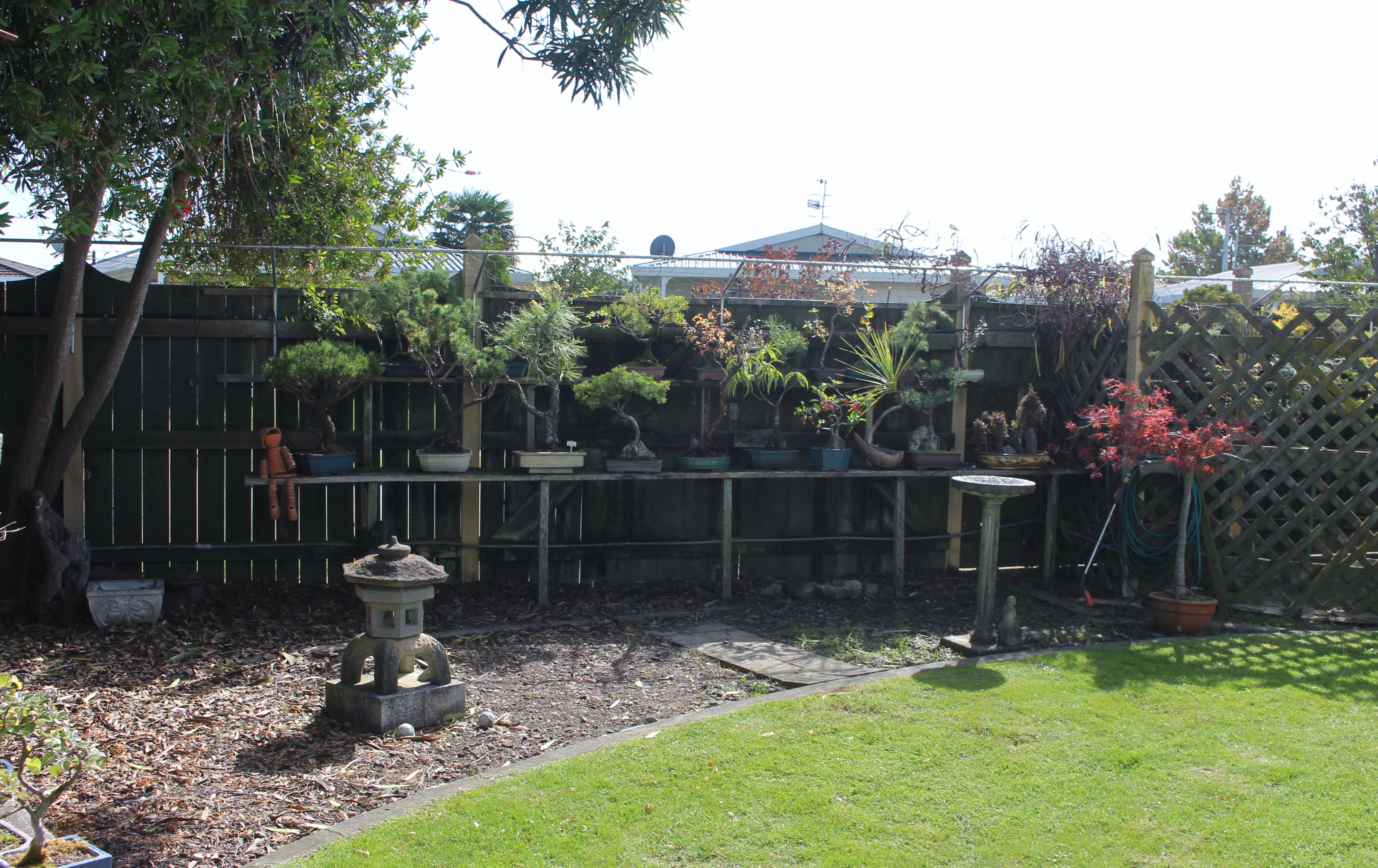
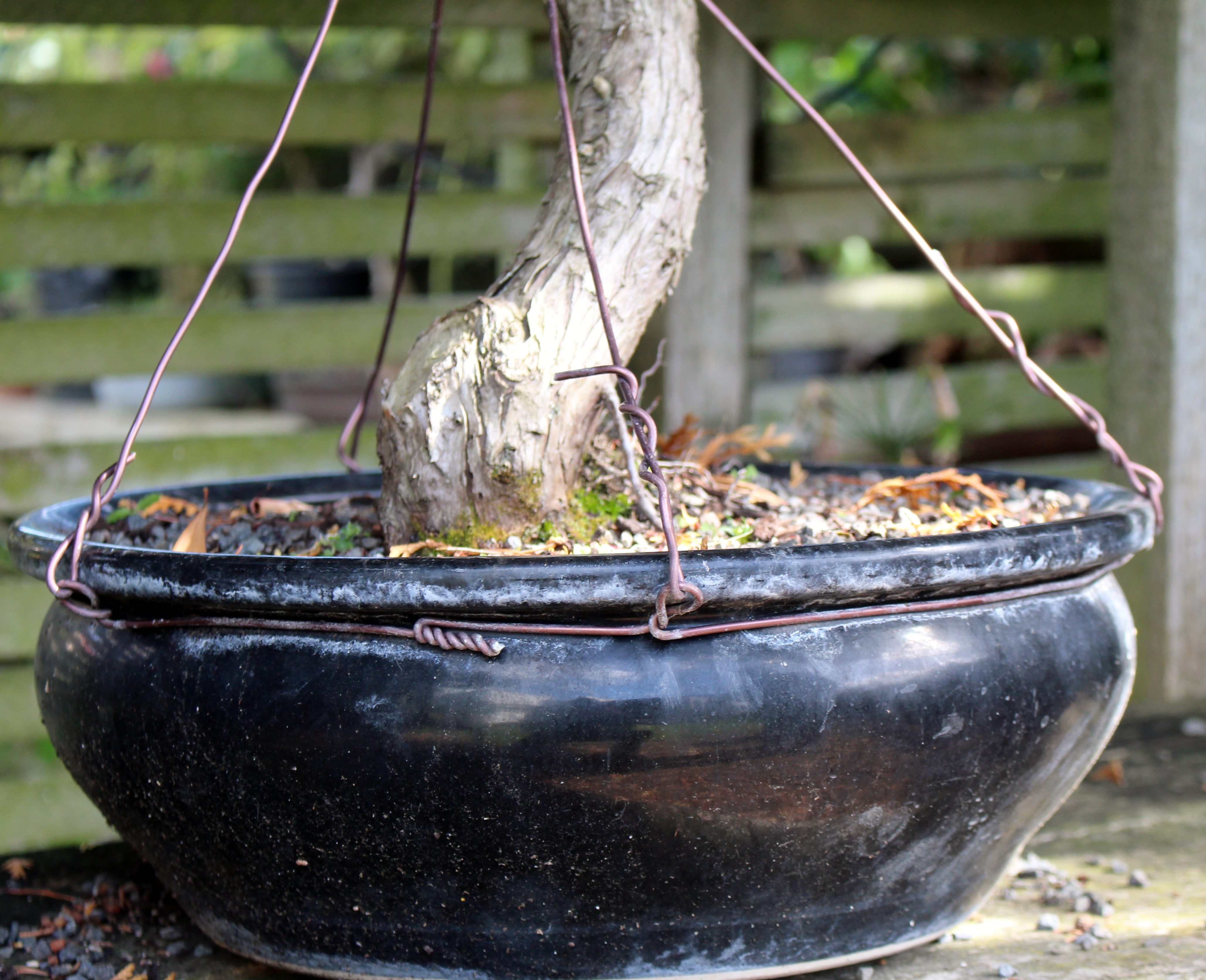
Ian Sayer 011Ian also gave me one of the newsletters that he produces for the club. He produces an eight page booklet every month. These contain a variety of information on Bonsai. Ian also organised the National Conference in Napier in 2007. This took place in Ahuriri in a theater hall. A highlight for him was having the Engelbrecht family on stage for a demonstration.

Ian Sayer 026Ian is worried about the lack of growth of Bonsai in New Zealand. He says we need to get our Bonsai trees out into the public arena, have more open displays and demonstrations. Like me, he believes that there are gems (Ian is one of them) tucked away in backyards all across New Zealand. He mentioned the names of John Austin and Bill Young, two people in the Hawke’s Bay with excellent trees. Ian says that it all starts in Clubs. We have to get the current ones more active and to participate in club activities. The best way to do this is to shoulder tap club members and ask them to do specific things. Most people do not say no and with support will grow within themselves and their Bonsai trees will follow.Ian Sayer 051

I am sure that with Ian Sayer in the saddle at Hawke’s Bay Bonsai, the club will grow very strong again. I am personally quite excited as we had preliminary talks about a combined display in the Tararua district to promote Bonsai here. Thank you for the time spent with you, Ian.Ian Sayer 034

Ian Sayer 052

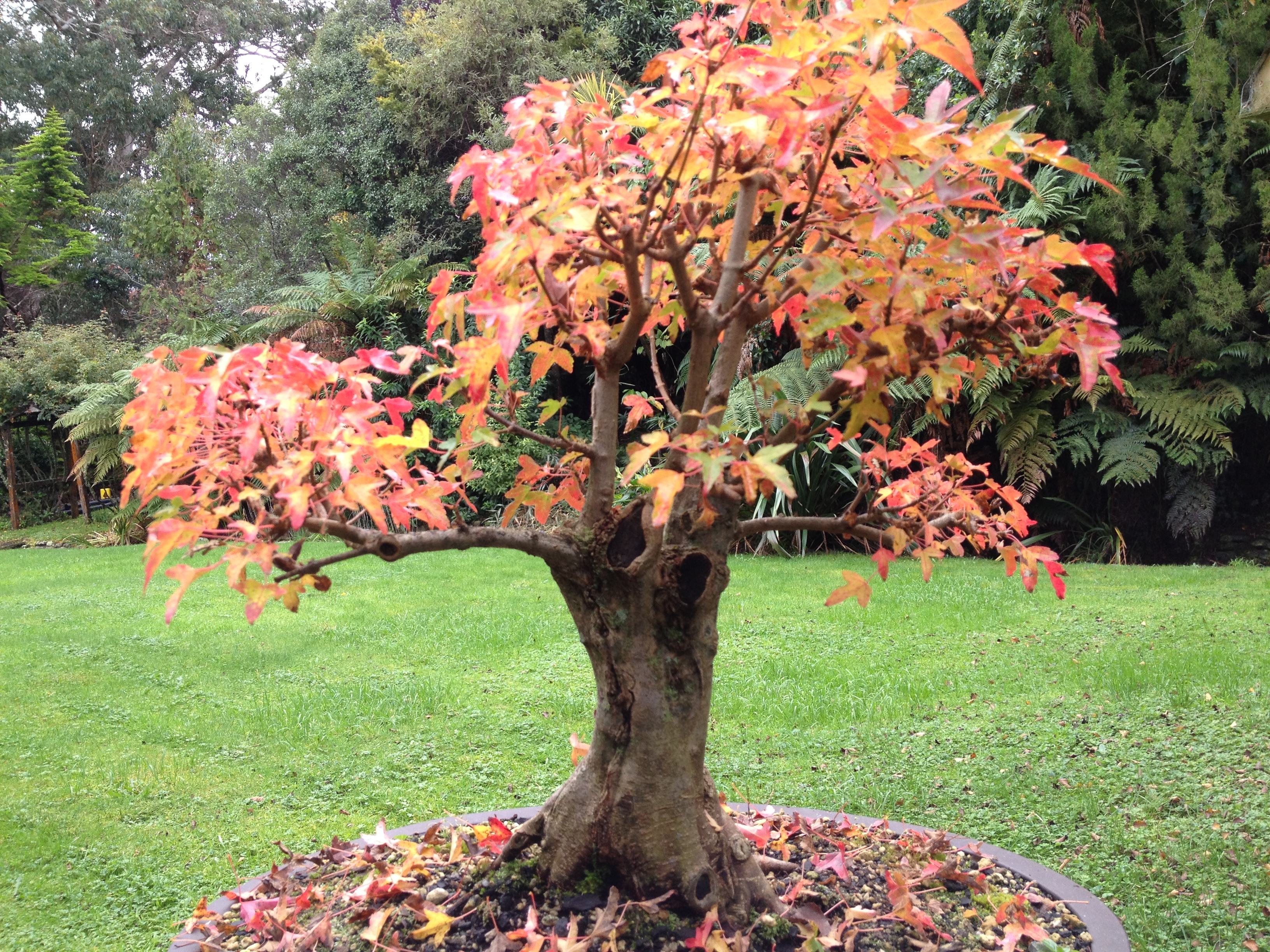
Shorter days, colorful leaves.

IMG_1899For us in the Southern hemisphere the leaves of our deciduous Bonsai trees are starting to change color and they will soon be on the ground. In the Northern hemisphere Spring growth is to be seen everywhere and I have noticed a proliferation of photos indicating just that on Social Media. The difference is that the daylight hours are getting less in the South and the opposite is happening in the North. Suffice to say then that it must be the availability and intensity of light that triggers these phenomena. Today I would like to explore the color changes in leaves during Autumn.

IMG_1235We know that there is a pigment in leaves called chlorophyll. It is the site where photosynthesis takes place in leaves. This is the process where water and carbon dioxide gas with the aid of light energy is converted into sugars for plants to use as food or to be stored.

As the days (light) get shorter, there is not enough light energy for photosynthesis to take place at optimum levels. The trees must rest and basically shut down and the only food available to get through winter, is what is stored. As this progresses, chlorophyll disappears from the leaves and the bright green fades away. Chlorophyll is not the only color pigment in leaves. As the green fades, the other color pigments become visible. These are the yellows and orange colors (carotenoids). In some trees, like maples, the glucose produced during photosynthesis gets trapped in the leaves and the sunlight causes the leaves to turn this molecule into a red color. It is known that the cooler temperatures have a role to play in this. There are other pigments present as well. Red anthocyanin pigments can also be produced during this time.

Currently, my trees, and especially the Maples, are not showing the bright red colors yet. This is late for this time of year. Our night time temperatures have not dropped sufficiently for this to happen. Other climatic factors play a role as well. What is needed for all the splendor of autumn to show in our Bonsai trees is a warm, wet Spring, followed by a Summer with average temperatures and an average rainfall as well as an Autumn with many sunny days and relatively cold nights. There is nothing we can do about any of these except for controlling water, but it might be possible to shift trees in one’s garden during Summer and Autumn to make use of micro-climates caused by other plants and the layout of your garden.

Plant Hormones and Bonsai

Plant hormones have an affect on aspects of plant life. Every cell in a plant can produce plant hormones and these can act in that specific cell or it can be transported somewhere else. There are five major plant hormones; auxins, cytokinins, gibberellins, ethylene and abscisic acid.

5 April 2015 063

Auxins are referred to as growth hormones. These chemicals stimulate plant cells to elongate. They are mainly found in the tips of stems and branches. with this accumulation of auxins in the tips, growth in other parts are subdued. During pruning of Bonsai these tips are removed and the excess of auxins in these areas are reduced. This in turn will allow growth to take place lower down on these branches. This is the so-called apical dominant display. When the auxins are not there, the dominance is reduced and back budding will be allowed to occur. It will also allow branches lower down the tree to develop more. Auxins are also produced in roots.IMG_1888

The phenomenon of phototropism is directly attributable to auxin concentrations. Auxin moves away from light. It accumulates in the cells further away from light and will stimulate those cells to lengthen. As this growth is only on one side of the stem, it “pushes” the stem towards the light. This growth of plants towards light is what phototropism is all about. When we wire stems and branches and bend them in a specific direction, no role is played by auxins. We manually do what auxins will normally do. This also allows us to do things against what the normal plant hormones were programmed to do. We can as an example, bend a branch to force it to grow away from light.IMG_1248

Another practical implication for Bonsai enthusiasts is to regularly turn the trees on the benches as it will stimulate growth around the plant and not only on one side.

Cytokinins promotes cell division, in other words, growth. Where auxins will inhibit lateral buds, cytokinins will promote growth all over the tree. In the absence of auxins, cytokinins will cause lateral buds and dormant buds to grow. Pruning, candle removing and pinching of new growth will all aid in reducing auxin levels and promoting more lateral growth.

Gibberellins are responsible for shoot elongation, seed germination and fruit and flower development.

Absisic acid promotes seed dormancy. It also assists with the opening and closing of stomata.

Ethylene is a gas produced by ripe fruits.

IMG_1871