In a recent Blog post by Harry Harrington (Bonsai4me), I was amazed by this artist’s technique in creating deadwood. His carvings are superb. On the same day, I happened to be at a beach on the west coast of the North Island of New Zealand (Paraparaumu). The beach was filled with driftwood and I could not resist studying them to find inspiration to style dead wood when I get back home. Fortunately I had my iPhone with me and took the following photos. There is nothing like nature (and Harry Harrington) to create the ultimate natural deadwood designs. In studying these photos I did get a few ideas and now have to get the practice in to recreate this on trees.
Tag New Zealand
Pohutukawa as Bonsai

Root over rock as Bonsai
Metrosidorus excelsa, also known as the New Zealand Christmas tree and in Maori, Pohutukawa, is an interesting tree to style as Bonsai.

This looks like two smaller trees, simulating a clump style Bonsai.
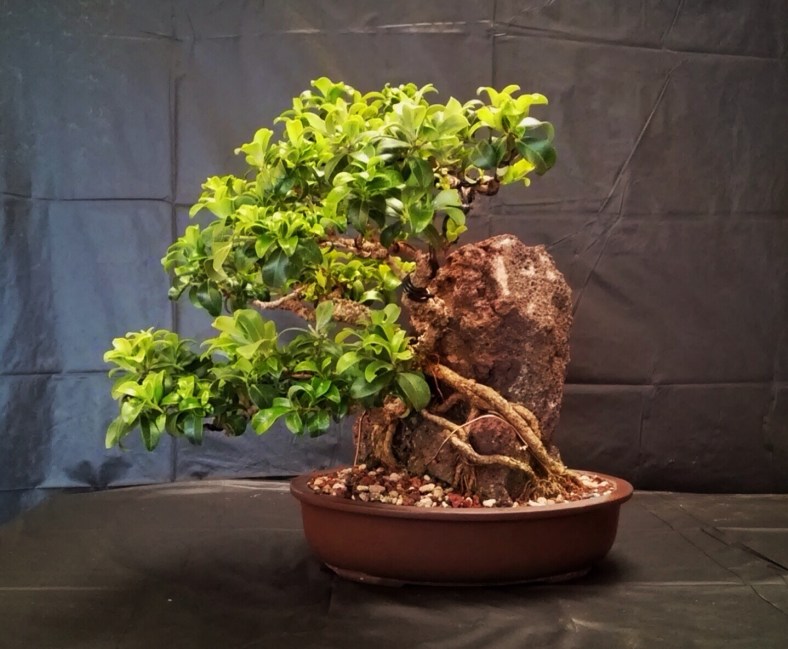
I have recently had the opportunity to photograph a few very old Pohutukawa trees in Mt Maunganui in New Zealand. I have no idea how old they are, but their form is quite distinctive when you study the trees in nature. From this I came to the conclusion that they are best suited for informal upright, clump style or root over rock style. They naturally grow aerial roots and form good bark on exposed roots. The red coloured flowers add to the spectacle. The three Bonsai photos are mainly from the http://www.nzbonsai.co.nz website and the http://www.bonsaiforbeginners.com site.
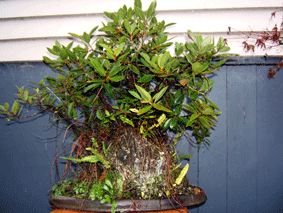
Masses of aerial roots makes it perfect for a root over rock style.
The next group of trees shows why I think the Pohutukawa is excellent material for root over rock style.
Some of these trees are also seen in nature as examples of an informal upright style.
I have also noticed some branches hanging very low, almost to the point of being a cascade or a semi-cascade.
I have been growing cuttings of another form of Meterosidorus, namely the Metrosideros kermadecensis. This tree has smaller leaves than the excelsa which is great for Bonsai. All these varieties are frost sensitive and needs protection in cold climates.
New Zealand Demonstrators
Ever wondered what New Zealand’s Bonsai Demonstrators look like? Here is the link:
Click on About NZBA, scroll down nd you will find the link to the Demonstrators there.
Newby

I have been following quite a lot of Blogs from well known and not so well known people within the Bonsai world. I am at that stage where I think I also have something to contribute. The best way for me is to do it through a Blog. My hope is to add some value to other Bonsai enthusiasts who are on this journey that never ends. I also contribute regularly to Bonsai Times, the New Zealand Bonsai Association’s official publication. My intention is to post those articles here as well.
My quest for knowledge has led me to Blogging. New Zealand has very strict laws in place to prevent the spreading of plant based pathogens. This means that we cannot import Bonsai and everything we have in our collections must come from within. The Bonsai community here is also relatively small and we are reliant on International exposure. This is mainly done through reading whatever we can get our hands on and by attending conventions and displays. The NZBA and host clubs do bring high caliber artists and demonstrators in and the knowledge that they spread is soaked up. The internet is also a huge help with Facebook putting many Bonsai enthusiasts in contact with each other.
My interests are focussed on the Philosophy, Art as well as the practical horticulture that provides the foundation for Bonsai. In exploring all of this, I have also recently started Vlogging. These videos are posted on You Tube and this Blog now gives me the opportunity to post those videos here as well.
So here goes …….
